Leadyne

Dr. Madana Kumar, PhD

Let Love be our First Priority

These are troubling times for all of us. Several of us are perturbed by the pain and suffering that is going on.  Where can we go for comfort? Where can we find solace? How can we comfort others? You must have heard the saying “ You can’t live on love and fresh air alone”. The underlying assumption behind this saying is that they are the only two things that are available free. Let us look at it in the context of today. Newspapers and social media are full of heart wrenching stories of people gasping for oxygen, something that is supposed to be available freely in fresh air. The air pollution in Delhi, India, for quite a number of years have taught us that we cannot take fresh air for granted. COVID has just reaffirmed that. We cannot take fresh air for granted. How about love? Is it free anymore? Is it available when we need it the most? Whatever your answer is for this question, the good news is that each one of us can make an effort to make the answer positive for others. Yes, if we turn around the question to “Do we love freely anymore? Is love our first priority in life? “ The picture will change for sure. I define Servant Leader as “A Servant Leader is someone who invests in the life of another person to the extent that the other person becomes better, bigger, wiser, richer, healthier, wealthier, happier, more famous than the leader themselves.” This should not be limited to formal leaders. This can be applied to each and everyone of us, immaterial of whether we hold a formal leadership position or not.  Let me suggest a few practical things we can do to take our love to this level Stop chasing success and start pursuing Significance. I have written about this in an earlier blog . Significance is when we use our success to add value to others. When we use our wisdom to lift up the foolish, when we spread our knowledge to educate the unlearned. When we use our wealth to help the poor, when we use our health to care for the sick, when we use our network to be able to help someone in need get the precious gift of an oxygenated bed when they most need it. If we just chase success alone, we will forget the people around us, and will be very busy achieving things one after another . but will not have time and inclination to use anyone that for someone else’s benefit. Look for opportunity to lift someone else above you. In an earlier blog, I spoke about the little child who could not see the festivities around her till the time the father decided to lift her up above him. There are a lot of souls around us today who need that uplifting. Smile at someone. Ask another person, how you can be helpful. Just lend a listening year to someone who needs to pour out their troubles. Mourn with someone who lost a loved one. Pray for them. Provide for them as much as you can. Don’t let distance and lockdowns hold you back. Understand and practice the deeper meaning of forgiveness and grace. In my blog on Emotional Healing, I spoke about the true meaning of Grace.  Don’t get caught up in the prison of unforgiveness and entitlement. Let us learn to let go and be willing to give others a second chance (and a third chance and an umpteenth chance). We are all messed up. Let us cut some slack for others to make their mistakes and learn from them. And if you are working professional, start by rewriting your job description. If your job description is all about results, and goals and projects, it is time to rewrite the same to include love for your employees/ team members in your Job description. In the podcast Key Mental Shifts for Servant Leadership, by Pete Mockaitis, available in LinkedIn Learning and lynda.com, the presenter describes a case study in Walt Disney Parks. As all of us are ware, Disney prides themselves in providing a magical experience to all their guests. They started getting complaints that the housekeeping staff was being rude or not responsive to several Guests. The analysis revealed an interesting fact. The housekeeping staff’s job description was to keep the park clean. They were focused on their job description to such an extent that when they saw a client throw trash all around it made them antagonistic to the guests. And if a guest who was throwing trash on the road, comes and asks the housekeeping staff for directions, the natural response is going to be, “I don’t know, I am just a janitor.”  They are thinking inside, “why I should I help this person, he just made my job harder by throwing trash on the road”. Once the leadership realised this, they changed the job description of the house keeping staff as “To create happy guests, to contribute to the happiness of our guests. How do you do that? Well, you provide them with directions when they need it. You give a kind smiling face when they ask you questions” and by the way, as an additional duty you also keep the park clean. This simple but definite switch to the Job description made a world of difference to the way the housekeeping staff treated the guests. The message is this. Change your job description to something that you can look forward to. Add love to your job description. Make the first sentence “ My job is to take care of the people I am entrusted with, to care for their wellbeing, to motivate them, to develop them, to help them grow and succeed ”. Don’t worry about the HR drafted job description that might remain in the HR systems. Go ahead and change the Job Description that you will live every working day of

Let Love be our First Priority Read More »
Putting Others First : An Imperative for a Great Post-Pandemic New Year

Permit me to ask you to do an exercise. Please do pardon me if you feel uncomfortable doing this exercise. Grab hold of a piece of paper and a pen. I would like you to think for a few  moments and write down all the major things you did during this year of the pandemic. All of us had a difficult year and at the same time, the year has opened up opportunities for several of us. We have adapted to several things during the year. Write it down.  It might be that your learned a new skill, you published a book, or It might be as simple as baking a cake, it might be buying cloths, it might be decorating the home or whatever. Think and write down please. If you have finished writing it down, go through the list and put a tick mark on the items that were done for others. If you baked the cake for the family, it counts. If you bought cloths for your wife (if she ever allows you to do that; my wife doesn’t trust in my taste, and I admittedly do not have any, in cloths) it doesn’t count (I am kidding, it does). Now, look through the ticked items and identify what you did for your immediate family, immediate relatives, and put another tick mark against the items you did for people outside your family circle.  Now sit back and reflect on the items that have the double tick marks. The year is coming to an end with the Christmas being over, Holiday Season coming to an end and a  Grand Finale of the New Year celebrations. This is a season of Joy and celebrations, especially as we are bidding goodbye to an arguably most difficult year this generation has faced. All of you know that I evangelize Servant Leadership in corporates, and other Organisations. That is my passion, that is my mission and that is the only legacy that I wish to leave. So, when people ask me to define a Servant Leader, I give them this definition. “A Servant Leader is someone who invests in the life of another person to the extent that the other person becomes better, bigger, wiser, richer, healthier, happier, wealthier, more famous than themselves.” All participants in my workshops are impressed by this definition of Servant Leadership, but soon the “Practical aspects” of  this definition starts raising its head. Does it mean that I will need to promote my direct report to be my manager?  Does it mean that I give an increment to my team member that his/her salary becomes double that of mine? Practical questions. So, I do have a practical definition, and I do provide a practical definition, so that they don’t get put off by the ideal definition of Servant Leadership that I had articulated above. But in this blog I want to intentionally keep away from the practical definition of Servant Leadership and ask that we embrace the concept of Putting Others First, in all its original intent. May this be our resolution for the new year. Putting Others First. Putting Others First is one of the 7 DEEP BHC behaviours that I had written about in an earlier blog.  My research shows that this is one of the lowest scoring behaviours in the 360 degree survey that we run before our SLAM workshops. Let us look at a true story. The story is true, but some of the interpretations are mine in the narration that I have given below. Picture Courtesy:  Kevin Carter’s Pulitzer Prize winning photograph of a Sudanese child and a vulture,   downloaded from https://en.wikipedia.org/wiki/The_vulture_and_the_little_girl#/media/File:Kevin-Carter-Child-Vulture-Sudan.jpg) Several of you have seen this picture before. This is a picture taken by photographer Kevin Carter in 1993. This is a picture of a famine stricken Sudanese child who was trying to reach the UN feeding center just half a mile away. The child (initially published as a girl, but later believed to be a boy) was exhausted and could not carry on and the vulture was waiting for its feed. Kevin took the picture and it was published in the New York Times. The horror of the famine that was prevalent in Sudan came alive through this picture and this picture alone brought international attention to the situation in Sudan and significantly increased the donations for relief work in Sudan. Kevin Carter went on to receive the Pulitzer prize for this picture. But the story does not end there. Questions were asked about what did Kevin do actually, after clicking the picture. It is reported that he remarked to his wife that he did chase away the vulture. Yes, chase away the vulture but left the child where he was. Kevin did not think it was necessary, or possible for him to help the child reach the feeding center. The situation in Sudan was very volatile and they had limited time (it seems) and their priority was to click photographs. That was the job that Kevin was charted for. So he did his job and certainly was rewarded handsomely for the great job he did. No one really knows for sure whether the boy survived or did really reach the feeding center finally. Kevin certainly did not know. The guilt and the horror of what he saw and what he did not do, weighed heavily on Kevin Carter and he committed suicide four months after receiving the Pulitzer prize. This is a sobering story for us to remember this holiday season. In our hurry to celebrate the season, have we missed someone’s urgent need? In our eagerness to do a great job at what we have been assigned to do, have missed noticing the need of another person? In our eagerness to protest against the restrictions we have had through the year about gathering, partying, worship etc, have we missed actions that could edify (build up) others? When we rejoice in healing that we or a loved

Putting Others First : An Imperative for a Great Post-Pandemic New Year Read More »

Power in Servant Leadership

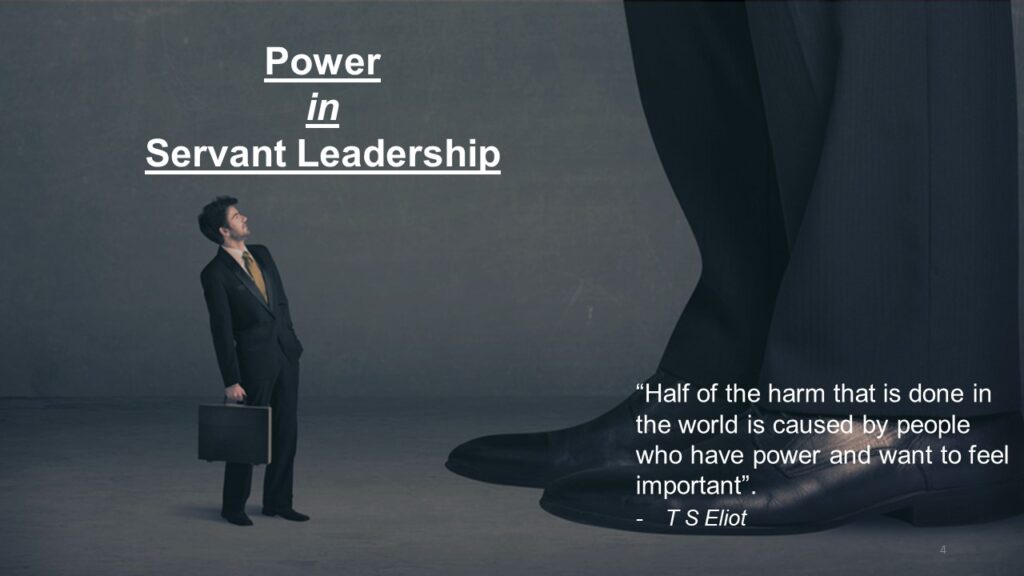
Leadership and Power has always been bed-fellows. We cannot think of one without the other. If we go with the definition that “Leadership is Influence”, then no one is really exempt from being a Leader. Does that mean everyone has some sort of power of otherwise? Researchers agree that we all have power, immaterial of whether hold positions or not. Social Psychologists John R. P . French and Bertram H. Raven conducted a remarkable study about power in 1959 and classified power into 5 separate and different forms. Susan Fowler and Ken Blanchard in their book, Self-Leadership and the One minute Manager speaks about 5 Points of Power that Self-Leaders need to be aware of. As they put it “Not realizing your own power could be your greatest assumed constraint.” In my studies about power, we have seen that each power that we have as an individual or as a leader can be used appropriately or can be misused. History records more of misuses than right uses of power. That is what prompted T S Eliot to say “ Half of the harm that is done in the world is caused by people who have power and want to feel important.”  I am sure we nod our heads in agreement at the quote by T S Eliot. We can reel out names of dictators and military generals and politicians who have proven this right, and many continue to prove this saying right even today. Corporates are not devoid of this malady either. It is an accepted norm for “Leaders” to have a bigger office, a reserved parking space, priority seating and servicing at office cafeteria etc. We have come to accept them as part of the office culture and normally do not worry about it. On a lighter note, we might have a laugh if we see an executive rest room in the office premises. Simon Sinek, in his book, Leaders eat last, talks about the former Merrill Lynch    CEO Stanley O’Neal. Stan’s story is a true rags to riches story that Ivy League Management Schools drool over. He did make it really big. He made it to the top position at Merrill Lynch in 2002. In his own words “Whatever I have achieved in life has been the result of the unique combination of luck, hard work, and opportunity that can only exist in this country. My grandfather, James O’Neal, was born into slavery in 1861.”  In the same year that he took over the CEO position at Merrill Lynch, O’Neal was named the “Most Powerful Black Executive in America” by Fortune magazine. Further instances show that he used that power in a very self-centered manner. He had his own private elevator to go to the 32nd floor and he restricted entry of employees to the floor. He used his  power to feel important, and thereby became secluded. This infiltrated into the leadership culture of the organisation. The New Yorker reports that some staffers were referring to the firm’s leaders as “the Taliban” and to O’Neal as “Mullah Omar.” Stan is known to have kept away from the employees and was in touch with only a handful of “faithful” ones. Many analysts believe that this was one of the major reasons for his downfall. He was forced to retire in October 2007, due to the pathetic performance of the company. The legacy that he left was not pleasant.  Jim Cramer, the host of “Mad Money,” on CNBC,  wrote  “This man was Wall Street’s Wicked Witch, a much-feared, totally unrespected hatchet man who appeared to be beloved by his troops but in reality didn’t have a friend in the joint. . . . I swear you could hear the cheering from downtown after he left.” On the other hand, Herb Kelleher, who founded the Southwest Airlines, had a very different idea about Power. He said “Power should be reserved for weightlifting and boats, and leadership really involves responsibility.” And several analysts agree that he was not faking anything. Terry Maxon of Dallas Morning News reports “Whether it’s hugging and kissing co-workers at a meeting or making a 2 a.m. visit to a maintenance hangar, Mr. Kelleher is not happy unless he’s talking with employees.” And what legacy did he leave? Apart from leaving behind the worlds’ most profitable airline company, he also left several thousand employees raving fans of himself. Take a look at what the employees did to thank him. And that legacy did live on in Southwest. Collen Barret , another rags to riches story, and the first woman to have headed a major airline company, took over the President role from Herb. Colleen says “85% of my time is spent on employees and delivering  pro-active customer services to employees.” Closer home, Girish Kuber, who wrote the book “The Tatas – How a Family built a Business and a Nation” narrates the story of Jehangir Ratanji Dadabhoy Tata , more popularly known as JRD. One of the first actions that JRD did was to take away the special privileges of officers in Tata Steel Plant at Jamshedpur. This included the special reserved lift for the Managing Director, Special dining areas for officers, and special toilets for officers. If you think this was no big deal, think again. This action was taken in the early 1940’s, when such privileges’ were considered absolutely normal. It was the time of British Raj and sahibs in India. JRD used his powers to make everyone equal, instead of seeking importance for himself or the others in office. It is not the absence of power that differentiates Servant Leaders from Traditional Leaders. It is the conscious choice that they make to use the power that they have for the benefit of the employees. Shakespeare knew it well. He said in his Sonnet No 94 They that have power to hurt and will do none, That do not do the thing they most do show, Who, moving others, are themselves as stone, Unmoved, cold,

Power in Servant Leadership Read More »

The Implementation Role of Leadership : Empowerment through Empathy

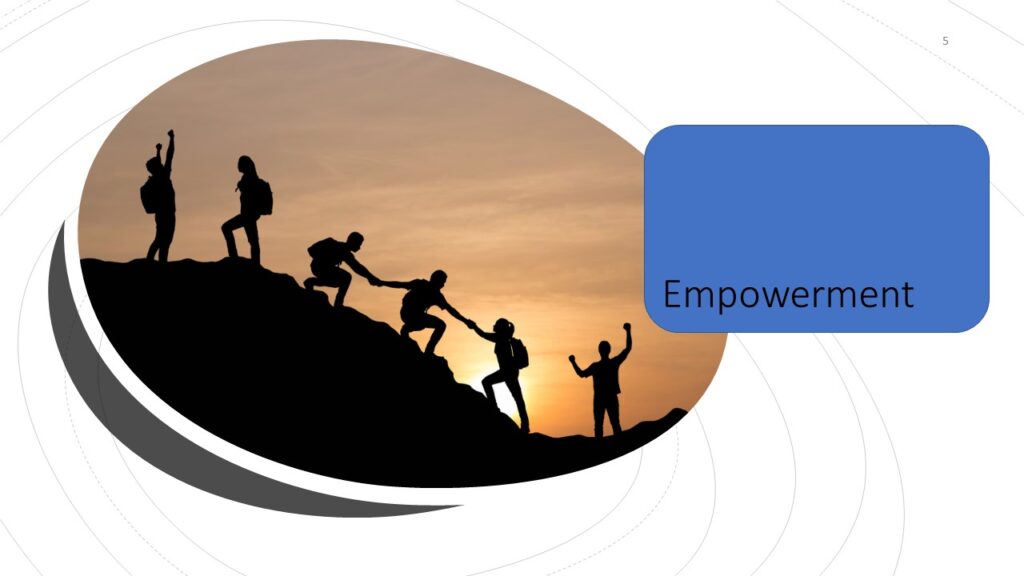
In my previous blog I discussed the need for Servant Leaders to be able to dream big and keep boundaries while chasing such dreams. At Leadyne, we call it the behaviour of Demonstrating Conceptual Skills. This is the beginning of great organisations. So, what is next? Is setting a higher purpose vision and goals enough by itself? The obvious answer is “No”. Visioning is one of the two key leadership roles. The second one is Implementation. During Implementation of the vision, mission, goals and values, Servant Leaders step aside and invert the pyramid. They create a culture where the employees feel they are fully responsible for the implementation of the vision, mission , values and goals. However the employees also know that the leaders have not gone anywhere. They know they can call upon the leaders as a resource when they need. The employees become responsible and the leaders become responsive to the employees’ needs. They serve the employees in fulfilling the organisation’s vision, mission, values and Goals. This concept is called the “Inverted Pyramid” and is an integral part of Servant Leadership Culture. To make the Inverted Pyramid work, Servant Leaders rely on another of the DEEP BHC behaviours viz; Empowerment. It is a very commonly used word. But let us dig a little deep into it. Is Empowerment something that you “give” to your followers? Have you heard some leaders claim “I have empowered my team fully.”  When Empowerment is something that the leader “gives” to their followers, the leader is implying that the power remains with me and I give you the part of that power. This is like claiming that you are most humble person in the whole wide world. Empowerment is not something given, but Empowerment is a climate that is felt by the followers. When they feel that they are Empowered to make decisions, even make mistakes, that is true empowerment. Chris Croft talks about the Freedom Ladder. Servant Leaders need to make conscious efforts to bring their people up the ladder, not by mere words but by appropriate behaviour. Let us take this conversation for example. Quote John: Hi Vinod. I found a problem with the code that we were supposed to release for the client yesterday and I have solved it by making some adjustments. I have released it to the clients and met the timelines committed. Just wanted to let you know and see what you think Vinod: Thanks John. You did well. May I suggest that in future, you pass such things through me before you release it to the clients? Unquote What do you think just happened here? John was at level 4 of the Freedom ladder and wanted to operate from there. Vinod’s reaction was a very clear message that Vinod wants John to be at level 3 of the Freedom ladder. What do you think John will do next time when faced with a situation like this? John is going to suggest and wait for Vinod’s approval before he does anything. In other words, knowingly or unknowingly Vinod has “pushed” John to Level 3 of the Freedom Ladder. This is what happens when the leader is not sensitive to the feelings of the team members while responding, even when the leader considers himself/ herself as am “empowering” leader. Therefore, at Leadyne, we map the behaviour of Empowerment to the attribute of Empathy. Unless as a leader is able to put himself/herself in the shoes of the employee and understand how they feel, empowerment cannot happen. It is important for leaders to understand what the team members think and feel. That is why I said at the beginning that Empowerment is a climate that the team member feels. True empowerment needs that you demonstrate behaviours that will help and encourage your team members to operate from Level 4 or level 5 of the Freedom ladder. Sure, there are risks in doing this. But in the long run, it will become a much stronger team and you as a leader will have a lot of time in your hands for doing higher purpose activities. Come join the Servant Leadership Movement and learn how to make your teams feel empowered. _____________________________________________________________________________________ Dr. Madana Kumar is the Servant Leadership Evangelist and Chief Consultant at Leadyne. You can contact him here.   __________________________________________________________________________________ Contact Leadyne if you would like to know the level of Empowerment in your team and wish to improve that.

The Implementation Role of Leadership : Empowerment through Empathy Read More »

Demonstrating Conceptual Skills: Taking Servant Leadership from Oxymoron to Reality

One of the biggest stumbling blocks for acceptance of Servant Leadership in corporate circles is the belief that Servant Leadership is an oxymoron. Critics of Servant Leadership often ask the question “How can one be a servant and a leader at the same time?”. The original definition given by Robert Greenleaf that “A Servant Leader is a servant first…” did not make it any easier for the concept to get acceptance in wider circles. This apparent contradiction in the term is what made Servant Leadership acquire an esoteric nature for quite a long time after it was propounded by Robert Greenleaf in 1970. Several Leadership gurus have tried to break that oxymoron nature of Servant Leadership recently. Notable among them are the works of Ken Blanchard.  Ken dives into the two leadership roles of Vision and Implementation to explain how Servant Leadership fulfills both the roles with a difference. In this blog, let us look at the first leadership role, viz; visioning. In a previous blog I had described the DEEP BHC Behaviours. You will notice that the first behaviour that we have listed there is Demonstrating Conceptual Skills. This is the behaviour that helps a Servant Leader to set a vision for self and the team and/or organisation. This essentially requires two skills viz; Conceptualisation and  Foresight. Conceptualisation is the skill to dream Big Dreams. Servant-leaders seek to nurture their abilities to “dream great dreams.” But what does this actually mean? The ability to look at a problem (or an organization) from a conceptualizing perspective means that one must think beyond day-to-day realities. While we must focus on day to day realities, we should be able to look beyond them and see beyond what is there today. As children we do this intrinsically. As we grow up, we tend to lose this ability to dream big. History shows that  leaders who dreamt big made a difference. Martin Luther King had a dream and that changed the US society. Mahatma Gandhi had a dream that made India achieve independence through non-violence. Nelson Mandela had a dream that changed Africa. Walt Disney had a dream that made Disney Land a preferred place for everyone. Herb Kelleher dreamt of an airline that will give its customers more for less . Let me quote Herb “One of the things that people, I think, didn’t understand is that we started out saying we’re going to give you more for less, not less for less. We’re going to give you new airplanes, not old airplanes. We’re going to give you the best on-time performance. We’re going to give you the people who are most hospitable.”. This was a crazy dream way back in 1971, in one of the most competitive and difficult industries to be in. Chasing dreams at any cost, without boundaries can be dangerous. Servant-leaders must seek a delicate balance between conceptualization and day-to-day focus. That is where the second skill of Foresight comes on. Foresight is the ability to learn from our past experiences, our current realities and the possible consequences of our actions in future. This is what defines the boundaries of what an organisation will do to go after the big dream that they have/had. Several organisations with big dreams flounder and fall through the crack, because they chase their dreams, not paying attention to boundaries. The cases of Enron, or Exxon, or Satyam or Kingfisher Airlines are classic examples of chasing big dreams without foresight. Successful organisations use their foresight to channel the process of chasing the dreams within certain boundaries. Walt Disney did it with their set of values. So did Southwest Airlines. The story of Tata as a group is an interesting study of this aspect too. Let me quote Ratan Tata “Business, as I have seen it, places one great demand on you: it needs you to self-impose a framework of ethics, values, fairness and objectivity on yourself at all times.” Integrity is the top value at Tata Group and that makes them one of the most respected business houses of all times. So this combination of conceptualization and foresight is what results in the behaviour of Servant Leaders Demonstrating Conceptual Skills. This  bursts the oxymoron nature of Servant Leadership. Servant Leaders dream big and have the foresight to avoid the pitfalls of chasing that dream without boundaries. Servant Leaders take on the responsibility of Setting the vision, mission, values and goals for the organisation, and the employees respond to such a vision.   Come Dream Big and join the Servant Leadership Movement. Develop the behaviour of Demonstrating Conceptual Skills We will discuss how Servant Leaders make a difference during the implementation of a vision in the next blog. Watch this space. __________________________________________________________________________________ Dr. Madana Kumar is the Servant Leadership Evangelist and Chief Consultant at Leadyne. You can contact him here. _________________________________________________________________________________ If you would like to know how to develop this behaviour of Demonstrating Conceptual Skills and be a Servant Leader, come and join our SLAM workshops or contact us here.

Demonstrating Conceptual Skills: Taking Servant Leadership from Oxymoron to Reality Read More »

Individual Contributor or Self-Leader? A Servant Leader’s point of view

Servant Leadership for Self Leaders

It is quite some time since the term “Individual Contributors” made an entry into the Corporate HR jargon. We assumed that almost everyone starts off as an individual contributor and then grows in the organisation to take up leadership roles and responsibilities. Thus, the term Individual Contributor came mostly to be associated with the bottom of the pyramid in the corporate hierarchy. Then companies started realizing that there might be value in encouraging Individual contributors to stay in that role, especially if they are experts in some field or technology. Companies like IBM even created curated career paths for them, so they don’t have to ever take up managerial positions to grow up the corporate ladder,  but can reach senior positions without taking up management positions at all. Studies reveal that developmental efforts for Individual Contributors is focused more on their technical or task-oriented skills and might be for specific roles. Focused investment in “Leadership Development” of Individual contributors was not a focus. Jack Zenger in his article in the Forbes Magazine (way back in Feb 2014) claimed that Individual contributors are “Forgotten Leaders” in investment from organisations on Leadership development activities. Several Organisations ask, “What has leadership development got to do with Individual contributors?” That led me to the question. How about Servant Leadership? Can an organisation really develop a Servant Leadership Culture by focusing only on who we traditionally call leaders? And the answer is “no”. A Servant Leadership culture requires that we focus on this group of “forgotten leaders” as much as we focus on traditional leaders. All individual contributors are “leaders” if we go by the definition “Leadership is Influence”. That is why I refer to Individual Contributors as Self-Leaders. What do these Self-Leaders need to do so they can take the best advantage of a Servant Leadership culture in the organisation? What attributes or mindset changes or behavioural changes do they need to embrace so they thrive in a Servant Leadership Culture and make the organisation successful? My studies show that there are three areas where they need to develop. (Ken Blanchard and Susan Fowler articulate this better in their book “Self-Leadership and the One Minute Manager”) Understand and overcome one’s Assumed Constraints: Susan Fowler speaks about the Elephant syndrome in several of her writings to explain Assumed constraints. The fact is that several of us end up assuming that there are several constraints that prevent us from becoming the best we can be. A significant Self-leader will strive to understand ones assumed constraints and look for ways of overcoming those. They will break the “permission paradox”  (a felt need to have explicit approval of someone before taking any action) and climb up the Freedom Ladder/ Autonomy ladder to become empowered employees and team members. Understand and use “Points of Power” the right way: Everyone, immaterial of any position or seniority, has some powers. As history proves repeatedly, it is not the absence of power that differentiates infamous leaders from the excellent ones. It is how they (choose to) use their powers. A Self-leader will understand his/her own points of power and the points of power of their team members. Once they have this understanding, they will then use this knowledge to bring fulfilment to self and success to the team. Self-leaders aware of their points of power will use such knowledge to collaborate rather than for conflict. Understand what you “need” to be significant: Self-leaders need to understand that chasing success is not the right thing to do. Individual success might bring in some temporary happiness, but it is in adding value to others that we find fulfilment. This is what we call significance. Self-Leaders will know what they need to be significant and they will know the right way to ask for the same. This awareness of your own “significance needs” will help you understand the current development stage that one is in. This will help in prioritising your goals so you can focus on the most significant ones. These are the building blocks for Self-Leadership. So let us not forget the “Individual Contributors”. Let us invest in them and make them significant Self-leaders. This will speed up the spread of Servant Leadership culture within the organisation. _______________________________________________________________________________________ Dr. Madana Kumar is the Servant Leadership Evangelist and Chief Consultant at Leadyne. You can contact him here _____________________________________________________________________________________ If you would like to know more about how Servant Leadership can be made practical for Individual Contributors, do get in touch with us .

Individual Contributor or Self-Leader? A Servant Leader’s point of view Read More »

Nebulous to Specific: Measuring Servant Leadership Behaviors

  All of us have heard the cliché “ What can be measured can be improved”. One of the several myths associated with Servant Leadership was that it is a nebulous concept which cannot be quantified and/ or measured. This myth was strengthened by the views of the early proponents of Servant Leadership who were not in favour of “measuring” Servant leadership attributes. The focus was on experiential understanding of the concept. Don Frick, who wrote about Robert Greenleaf, was probably referring to the father of the term himself when he said that it was believed that if servant leadership was reduced to a collection of admirable qualities and learned skills that were displayed in organisational settings, it was all too easy to forget that servant leadership was, first about deep identity.  Another apprehension was that we may feel guilty and frustrated for not measuring up to this set of leadership ideals and that we may even project these ideals onto others; expecting them to do what we could not attain ourselves. Due to this, most of the early writings on Servant leadership have been based on anecdotal observations, personal testimonies and reflections. However, a body of researchers argued against this view and attempted measuring Servant leadership attributes. In the early 2000’s many researchers came up with scales that measure Servant Leadership behaviours. Picking up on this research, and banking on a scale that was developed and validated by Dr. Robert C Liden, I developed a scale called the Menorah Servant Leadership Assessment (MSLA) , as part of my doctoral studies. Making it part of the doctoral studies ensured that the scale went through rigorous validations tests and can relied upon. So, the good news is that Servant Leadership behaviour can be measured. The MSLA measures Servant Leadership against seven distinct behaviours we call as the DEEP BHC behaviours. Let us look at them briefly MSLA measures these seven behaviours as a 360 degree assessment. It gives an opportunity for the leader to compare own perception with what others actually see. It also gives an idea of how the  leader stands with respect to a global population and/or his/her organisation. MSLA is a great tool for self-awareness for all leaders. You can get more details about the MSLA here. So, Now that you know that Servant Leadership is  measurable, it is no more considered a nebulous concept. Come, take the MSLA assessment and be a great Servant Leader. Your Servant Leadership journey starts with a 360 degree assessment. _______________________________________________________________________________ Dr. Madana Kumar, PhD is the Servant Leadership Evangelist and Chief Consultant at Leadyne. You can contact him here.

Nebulous to Specific: Measuring Servant Leadership Behaviors Read More »

Servant Leadership in Action for Momentum (S.L.A.M) – Virtual Workshop October 19 and 20, 2020

If you are ready, go directly to the Registration Page, else read on Important Point to note:  The workshop uses the report of a 360 degree assessment and hence registrations will close on 10th of October 2020, to allow time for the 360 degree assessment. You are convinced that Servant Leadership is the best suited Leadership Philosophy for the New Normal. (If you still need convincing, please read our compelling reasons at this link) COVID 19 is preventing us from getting together to equip ourselves. But there is Good news. You can start your Servant Leadership Journey without waiting for the lockdowns to be over. Get equipped over the Virtual Platform Dates: 19th and 20th of October 2020 Location: From the comfort of your home, anywhere in the world (Virtual platform) If you are ready, go directly to the Registration Page, else read on What is SLAM? SLAM is based on a methodology that is proven by organisation wide implementation in a Billion Dollar Global Corporate (22000 employees, 25 countries), a large Deemed University (18000 students and 800 faculty members) and a National NGO with more than 2300 branches and a reach of over 125000 people. It is a two day intensive, interactive, action oriented workshop based on a 360 degree assessment. What is the Structure of SLAM? SLAM uses the four tiered structure of 360 Degree Assessment Workshop Coaching Self-reliance Why is SLAM unique? It breaks all the myths about Servant Leadership and elevates it to completely practical and pragmatic levels. It is personal, because it is based on your personal 360 degree assessment report on 7 DEEP BHC behaviours It addresses the whole person, as it prepares you for transformation at the four domains of Heart, Head, Hands and Habits It is practical , as it ends with a personal practice guide that guides your actions after the workshop It is enduring as it offers an optional coaching engagement to implement the action plans. What are others saying about SLAM? Phinu Joseph: Facilitator who is Sooper Lively Amazing and Magnanimous-SLAM with his job! Team Camaraderie, Frequent Wake-Up Calls, Unhurried Pace, Non-Judgemental Discussions. Thoroughly enjoyed every minute Arun C. Antony Fr.: The (SLAM) workshop was so unique in the sense you were continuously reflecting and introspecting about the philosophy of Servant Leadership. Hence believe this has bbeen a true life changing experience. I really hope to modify, adopt this style. For more testimonials visit our Testimonials page Testimonials About the Designer and Facilitator: SLAM is designed and delivered by Dr. Madana Kumar, PhD, an industry veteran with close to 4 decades of experience, based on extensive research (including his Doctoral dissertation) and hands on experience.  You can get to know more about him here. Investment required: INR Rs.16737/- + GST = 19750/- per participant (includes 18% GST, a 360 degree MSLA report of Rs 7500/ value and a Participant handbook cum practice guide of Rs 1000 value) Early Bird discount of 10% available till 30th of September 2020 Attractive Group discounts available. Please contact for details. Important Point to note:  The workshop uses the report of a 360 degree assessment and hence registrations will close on 10th of October 2020, to allow time for the 360 degree assessment. If you still have questions or need help with registration, Contact : Mr. John Manoharan E-mail: jm@leadyne.com Phone: +91 9742655777, +91 9880098454 Registration Form Loading…

Servant Leadership in Action for Momentum (S.L.A.M) – Virtual Workshop October 19 and 20, 2020 Read More »

Victim, Villain, Hero or a Fourth Alternative?

By now, you must have heard it a thousand times. We are living in unprecedented times. We are going through trials. We are preparing for the Future Shock or a new normal. The world is not going to be the same again etc etc. We cannot escape the reality of the pandemic that is still raging out there. But we are also encouraged by the fact that life is slowly limping back to normal. Most of us are learning to “live with” the pandemic. In this blog,  I will ask us to turn the attention on us, on our responses, on how we respond to such trying times. And what can we do as leaders, to be a lot more effective in such situations. Recently I had the privilege of listening to the author Don Phin, and then read his book, the 40-40 Solution. Don Phin talks about three roles generally all of us audition for viz;, Victim, Villain or Hero.  The book inspired me to think about these three categories in a different context.  My studies show that these three are the standard responses of people to troubles. Come to think of it, you will see these three roles in any Hollywood or Bollywood movie that you catch on Netflix or Amazon prime or Hot-star or wherever you see movies during the pandemic. Let us look at each one of these three and see which one fits us more. The Victim response is probably the most familiar one to all of us. When faced with troubles the Victim will feel that it is unfair. The victim will feel singled out. The victim will think the entire world is conspiring against him/her. Their conversation with friends will be about how hard life is. They will strongly feel that others are more blessed than themselves. They truly believe that others do not know how difficult his/her situation really is. They will blame others and/or situations for their suffering and troubles. They think no matter how hard they try, their situation will not change. They find it difficult to get over the past mistakes and failures, and they perpetually live in guilt. You can add on to this list, but I am sure all of us have felt some of the above sometime or the other. Victims are people who feel some of these often. Psychologists opine that Victims, as and when they can get out of the victim state, end up becoming either a Villain or a Hero.  The Victim to Villain transition is very natural..  When one gets fed up with staying in the victim stage, a victim will start planning actions that can hurt others. That is when the Villain is born. A Villain will take revenge. A villain will become aggressive, violent, and will hit back at others with whatever he/she can. A villain will not worry about public opinion. A villain will soon start enjoying the role so much that he/she will fall in love with themselves in that role to the detriment of others.  Many of us might not be explicitly getting into a villain role, but think again. We are taking the villain role, when we scream at someone, we are taking the villain role when anger gets the better of us, whether it is at home or outside. Sometimes we get into a villain role without even realizing it. A more positive transition is the one from Victim to Hero. A Hero does not have to come out of a victim. Heroes emerge otherwise, too. A Hero wants to save. This is what psychologists call the Savior’s Complex.  Someone with a Hero Mentality will swoop down on a suffering victim and do all that is necessary to save him/her. At the outset, you may think there is nothing wrong with being a Hero. But think again. All that the Hero might care about is saving the Victim. A Hero might not seek the Victim’s permission or acceptance before getting into the saving act. He/ she might not enable the victim to get over the situation. The Hero might not bother about making the victim self-sufficient. The Hero might not bother about their own safety and/or well-being while doing the saviors act. The Hero will sometimes even endanger himself or herself and many around them, including their own families to perform the rescue act. Let us pause for a moment and ask ourselves this question in the middle of the pandemic we are in. What role are  we auditioning for? Do we feel like a victim of the situation around us? Are we tempted to take on the Villain role, so we can take revenge or we can “pay back” for the sufferings we have gone through? Or are we donning the cape and taking the role of a superhero, trying to save everyone who is suffering, not bothered about our own safety and the well-being of the ones who love us? There is a fourth option, an option of being a Leader. We don’t have to be stuck inside the Victim-Villain-Hero Triangle. So what does the fourth option entail?  What does “Being a Leader” mean in this context? Being a leader as the fourth option here means we demonstrate the behaviour of Emotional Healing that I wrote about in a previous blog. It means Leaders who practice  the four habits that I wrote about in another  blog. It means we seek to add value to ourselves with the explicit purpose of adding value to others, as described in yet another blog on significance. It means being a Servant Leader. ______________________________________________________________________________________ Dr. Madana Kumar is the Chief Consultant and Servant Leadership Evangelist at Leadyne. You can contact him here.

Victim, Villain, Hero or a Fourth Alternative? Read More »

Social Distancing is NOT Emotional Distancing ; Emotional Healing is the Need of the Day

Social Distancing is the norm of the day. Ever since the declaration of COVID 19 as a pandemic, social distancing became a requirement and even a law at certain places. Most of us know that the actual meaning of the so-called social distancing is physical distancing. Physical distancing is a requirement to safeguard ourselves, our loved ones and others from getting infected with this virus on the prowl. During the early stages of the pandemic, the scare was so high that social distancing, many times morphed into social isolation. There are cases of neighbors “spying and reporting” on suspicious visitors to some homes. People in self-quarantine were looked upon with a lot of suspicion and fear. And it became actually a stigma for those who tested positive (and their families).  Pictures of the so called “migrant workers” walking thousands of Kilometers to reach back to their homes became a talking point in global media. Stories of patients being refused treatment in hospitals started flooding the media. Even dead bodies were not given the respect due to them. An unrelated incident in the US triggered strong racial tensions in the United States of America. I am sure I am not alone in having wondered sometimes, “Where is Humanity headed?” But then there were several silver linings among the ominous clouds. Several COVID heroes emerged. Thousands of people and organisations came up to augment the efforts of the government agencies in managing the “migrant worker’s” sufferings. The #BLM movement touched the conscience of Millions. This was a social movement across the globe. These two sides of the coin proved one thing to me. There are some who mistook Social Distancing to be Emotional Distancing, and there are others who took Social Distancing to be a time to actually practice the Servant Leadership behaviour of “Emotional Healing”. I have chosen to write about Emotional Healing, because I believe it is the need of the hour for the world, and business in particular. Emotional Healing is one of the DEEP BHC Behaviours  that mark out a Servant Leader from Traditional Leaders. This is the behaviour that makes Servant Leaders heal themselves and their relationship with others. My earlier blog on Four Habits  dwelt on some attributes that help develop the Emotional Healing Behaviour. True demonstration of Emotional Healing can happen only with a deep understanding of the concept of Grace. Several of us link Grace only with spirituality and faith and divine things. But practicing Grace is essential in today’s world, and it is possible for mere human beings. Only Grace can heal the world of the deep wounds that it is suffering from. So what does Grace mean in our day-to-day lives? Let us begin by looking at Justice. All of us understand Justice well. We build human society on the concept of Justice. Justice, simply put, is “When You Get What You Deserve”. You do something good, you get a proportionate reward, you do something bad, you get a proportionate punishment. All of us crave for justice. All of us raise our voices when injustice is done. This is an easily understood concept. Higher than the concept of Justice is the concept and practice of Mercy. When someone who deserved a punishment is sentenced to get that punishment, all that he/she can do is to plead for Mercy. All judicial systems make allowance for mercy pleas, executive heads can grant that. Mercy, in other words, is “When You are Spared of a Punishment that You Deserve”. So is there something higher than the concept of Mercy? This is where Grace comes in. Grace goes way above and beyond Justice and Mercy. Grace happens when we are not only spared of the punishment that we deserved , but we get a reward that we did not deserve. Grace is “Unmerited Benefit”. Sounds illogical? I agree, Grace is beyond logic. That is why we call it divine. Grace could even be termed as unfair. Yes, at first glance it might appear illogical and unfair. In an emotionally charged world, logic alone is not enough to heal the wounds that are inflicted upon us every day. We need Grace. Justice is required, and is not enough to heal the hurt that is caused due to incidents like George Floyd , or Nirbhaya  or  Pehlu Khan . We need Grace. Only Grace can heal the deep wounds caused by society’s ills. So is there a role for Grace in Business Leadership? Yes, next time when you are tempted to ask, “Does he/she really deserves that”, think about an alternative. Even if that employee does not deserve my time, I will make time for him/her. Even when a team member did not “earn” the right to be developed, I will invest in the development of the team member. Even if the employee has failed in the past, I will give him/her a second chance and entrust a recent project to him/her. Try it out. It will do a world of difference to your organisation’s culture. You may have one question though. Will people not misuse the concept of Grace? The answer is yes, there is a risk that someone might. History shows that every good deed of humanity has been misused by a small percentage of people. The question we need to ask is, should we hold back because a few people might misuse it (the command-and-control leadership), or should we dispense it because several will enjoy it (Servant Leadership)? So don’t let Social Distancing stop you from Emotionally Healing yourselves and your relationship with others, be it at home, in your neighbourhood or at work. Come practice the behaviour of Emotional Healing and join the Servant Leadership Movement. ______________________________________________________________________________________ Dr. Madana Kumar is the Chief Consultant and Servant Leadership Evangelist at Leadyne. You can contact him here.

Social Distancing is NOT Emotional Distancing ; Emotional Healing is the Need of the Day Read More »

Scroll to Top