Leadyne

Articles

Articles

ARISE : A Human Centered Coaching Process

As the business world gets more and more entrenched in the use of Generative AI, the need for “humanising” the culture is all the more evident. This work involves the worker, the workplace, the work processes and the leadership. Transition to the human centred culture is not easy and requires significant efforts. We have identified four areas that an organisation needs to invest in to be successful in this transition. Human Centred Coaching Human Centred Leadership Development Human Skills Human Centred Organisation Design This document describes the first item namely, Human Centred Coaching. Coaching is vitally important in bringing mindset changes and prepare leaders for the future. This is especially required for busy leaders who might not have the time and inclination to sit through Leadership Development programs. We use the ARISE model of leadership, developed and implemented by Dr. Madana Kumar, PhD. The ARISE model is explained below. While the overall flow is the same, the order in which the coaching takes place is not sacrosanct. it is possible that in one area, the coachee is at A stage, while in another the coachee is at I stage. It is also possible that during any of the other stages, the coachee might decide to revert back to the A stage to start all over again. A: Assess: This is the first stage of our coaching. During this phase we assess the following Goals Organisation Structure Critical Relationships Team Strengths and weaknesses Achievements and challenges Personality (Psychometric Assessment) Change Readiness (Psychometric assessment) Servant Leadership Behaviours (360 degree Psychometric assessment) 2. R: Reflect: In this phase of coaching we identify the coachee’s Strengths, Areas of Improvement, Overestimation and Underestimation. The coachee is guided through a process to analyse current behaviours, situations, feelings and reactions . The coachee is then challenged to ask “what if” questions, and consider alternative approaches to situations and challenges. The coachee is guided to a place where they identify changes they need to make in their behaviours at workplace and otherwise. 3. I: Implement Changes: In this phase the coachee is encouraged to implement changes that are required in any of the areas that they identified. Depending on the area of implementation appropriate job aids might be given, or the coachee might be directed to other resources for them to easily implement the changes required. 4. S: Seek Feedback: This is where the coachee needs to seek feedback on their changed behaviour and/or approach and/or attitude from key stakeholders. This feedback is usually done in one on one setting with key stakeholders. The coachee is encouraged to share the areas they identified for change, the changes they implemented and then seek to find out if the other stakeholders see any difference. This one on one feedback sessions could be complemented with a second 360 degree assessment. 5. E: Encore: Improvement is never a one time activity. The cycle needs to be repeated for continuous improvement. Our Model of ARISE coaching uses he strengths of the other established models of Coaching, and complements it with structured assessments,  guided reflections, help for implementation, job aids, and feedback processes. The process by design is an iterative process that gives the coachee the much required psychological safety to try out new and unconventional changes. _____________________________________________________________ Author: Dr. Madana Kumar, PhD is the Servant Leadership Evangelist at Leadyne. You can connect with him here, or contact him here. Contents are intellectual property of Dr. Madana Kumar and Leadyne. Copying and using is prohibited under the copyright laws.

ARISE : A Human Centered Coaching Process Read More »

Derailed by the desire to Win-too-much? Servant Leadership is the solution

  How to overcome the trap of ‘Winning Too Much’- The need to win at all costs and in all situations Is Winning Important? Yes, it benefits our development and quality of life. It may help us live longer. Winning does build confidence especially when that winning represents a true accomplishment; (i.e. beating a worthy opponent). Winning is a mindset shaped by an aptitude to shake off the disappointment you face. Winning in life means living authentically and finding joy and purpose in the journey. It also means continuously evolving through personal growth, challenging self, competing with self and thriving to be a better version of self. Whilst winning is important, we must also be acquainted with losing to support our reason to win. Losing affords us the gift of ascending the ladder of excellence while developing strength of character. It forces us to question our motives and many times we return stronger than before. Marshall Goldsmith, the noted author and leadership coach lists winning too much as habit #1 of the 20 habits that will derail leaders. [i] Winning too much is #1 challenge for most people It underlies nearly every other behavioural problem Arguing and putting other people down=> we want our view to prevail and position them beneath us Play favourites=> to gain allies so ‘our side’ has an advantage. Overlooking weakness=> less open to feedback Constant pressure to maintain winning streak by ignoring others and even behave unethically. Leading to toxic competition An unhealthy obsession with winning can foster a toxic competitive environment, alienating colleagues, partners and even loved ones, demeaning them, stabbing behind their back, spreading incorrect, unethical and unwarranted information about them and seeking sympathy for self. Reinafrida Rwezaura, a dynamic entrepreneur and youth advocate gives beautiful insights on how to avoid the pitfalls of the winning trap[ii]. To avoid the pitfalls of the winning trap, here are some tips: Embrace a growth mindset Keep seeking feedback Step out of comfort zone Redefine success Can Servant Leadership Attributes help us avoid the pitfalls of the winning trap? YES, the above pointers can be mapped with 3 major categories of the Servant Leadership 3-7-10 framework[iii]. The 3-7-10 structure is explained in Dr. Madana Kumar, PhD’s blog that you can find here 3 Major Categories: Vision related– Foresight, Conceptualization Character related– Awareness, Healing and Stewardship Relationship related– Empathy, listening, commitment to growth of others, building community and persuasion. Persuasion: Servant Leaders do not use positional authority in making and communicating decisions. They seek to convince others, rather than coerce compliance. They demonstrate all the other Servant Leadership attributes to reach a position where the followers choose to walk with the leader by their own free will. WIN as a team, as an organization When leaders invest in their people, based on the Servant Leadership attributes, we win as a team. This builds leaders at all levels in the organisation. Then the leader does not have to focus so much at “winning” because the team will do it for them.  This is the sure shot solution and cure for the desire to Win-Too-Much. ______________________________________________________________ References [i] Marshall Goldsmith | What Got You Here Won’t Get You There | pp 45-48 | MJF Books | New York | 2007 [ii]   Reinafrida Rwezaura – The Winning Trap: Why winners Can Crash and Burn,   accessed at https://medium.com/@reinafridarwezaura/the-winning-trap-why-winners-can-crash-and-burn-7fdb065632cf#: on 31st July 2024 [iii]The “How” of Servant Leadership | 3-7-10 Framework | Dr. Madana Kumar, PhD  https://leadyne.com/the-3-7-10-framework-mapping-2 ______________________________________________________ Author: Vaishnavi Karhadkar is an Experienced Delivery and Program Executive with a demonstrated history of working in the Information Technology and Services Industry. Her passion for the concept of Servant Leadership drew her to author this article. You can connect with  Vaishnavi here   With expert inputs from Dr. Madana Kumar, PhD. You can connect with Madana here or write to him here     .  

Derailed by the desire to Win-too-much? Servant Leadership is the solution Read More »

The “How” of Servant Leadership | 3-7-10 Framework | Dr. Madana Kumar, PhD

While the concept of Servant Leadership is relatively known and even admired, when it comes to the question of implementation, many leaders and organisations falter. This is why I have come up with the 3-7-10 framework of implementation for Servant Leadership. There are three imperatives that we need to embrace . These are Vision, Character and Relationships. Vision:  One of the key myths about Servant Leadership is that Servant Leaders are not visionary leaders. This is far from the truth. Servant Leaders provide a vision that is a higher purpose vision for themselves and their organisations.  This imperative is what bursts the oxymoron nature of Servant Leadership. Ken Blanchard says Leadership is about going somewhere. If you and your people don’t know where you are going, your leadership doesn’t matter. (Jesse Stoner, Ken Blanchard and Drea Zigami. Leading at a Higher level. Blanchard on Leadership and Creating High Performing Organisations.  Chapter 2. Blanchard International. 2010. Pp17 ) Character: Character is what makes us who we are. Character is a choice. Every time we exercise a choice in situations, we are molding our character. Character influences our behaviour significantly.  Servant Leaders work on developing the right character traits in themselves and others. Relationships: Leadership could become very lonely unless leaders nurture relationships with others. In an organisational context, processes can get you only average results. It is relationships that will get your excellent results.  Servant Leaders pay high attention to building and nurturing relationships with all stakeholders These three imperatives are out into practice through observable behaviours. We call them the DEEP BHC behaviours (you can read the descriptions of the DEEP BHC behaviours here). These behaviours are measurable through a 360 degree assessment. (more here) When a leader wants to improve on any particular behaviour, he/she will need to work on several attributes. There are ten attributes that one might need to work on. You can read about the attributes here. Sometimes it might look overwhelming to look at all of them. That is why we have arrived at a mapping between the Imperatives, Behaviours and Attributes. When in doubt, start with the what is mapped. But the mapping is not sacrosanct. All of them interact with each other. The mapping is provided to make it easier to get started. Once you get started, you will get the hang of what other elements you need to work on. The mapping is given below ________________________________________________________ The author Dr. Madana Kumar, PhD is the Servant Leadership Evangelist at Leadyne. You can connect with him here or contact him here.

The “How” of Servant Leadership | 3-7-10 Framework | Dr. Madana Kumar, PhD Read More »

Completing the 3-7-10 Framework | Servant Leadership Attributes | Dr. Madana Kumar, PhD

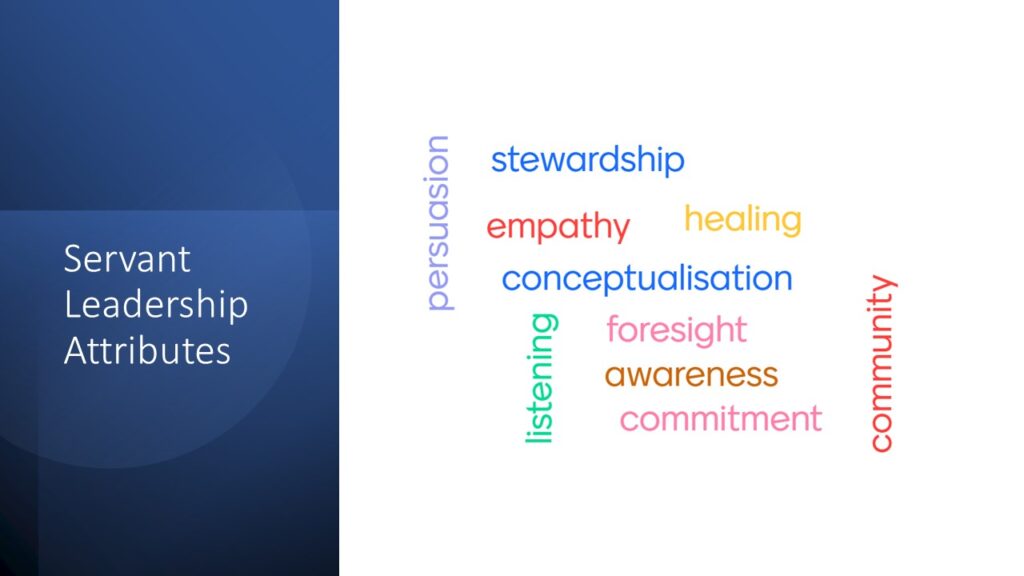
Our efforts have always been to answer the ‘how” of Servant Leadership. That is why we came up with the 3-7-10 framework. This framework is explained in another blog. This framework is made up of Three Imperatives (descriptions can be found here) Seven behaviours we call DEEP BHC (descriptions can be found here) Ten attributes In the blog we will look into the ten attributes. The 10 attributes used are the original ones propounded by Robert Greenleaf (1), who is known to be the father of modern-day Servant Leadership concept. These were further explained by Larry Spears (2). These are categorized (By Dr. Madana Kumar, PhD) into three categories, viz; Vision Related, Character Related and Relationships related. Vision Related Foresight: A characteristic that enables Servant-leaders to understand lessons from the past, the realities of the present, and the likely consequence of a decision in the future. It is deeply rooted in the intuitive mind. Conceptualization: Servant-leaders seek to nurture their abilities to “dream great dreams.” The ability to look at a problem (or an organization) from a conceptualizing perspective means that one must think beyond day-to-day realities. While we must focus on day to day realities, we should be able to look beyond them and see beyond what is there today. Servant-leaders must seek a delicate balance between conceptualization and day-to-day focus. Character Related Awareness: Self-awareness is always the first step to leadership. We can change and improve when we know our strengths and weak areas. Servant Leaders have a high sense of self-awareness, and they constantly enhance this through a continuous and genuine feedback mechanism Healing: Learning to heal is a powerful force for transformation and integration. One of the great strengths of servant-leadership is the potential for healing one’s self and others. This requires us to master the concept of forgiveness, and a deeper understanding of grace. Stewardship: Servant Leaders are expected behave like stewards of the things on earth and not as owners. Servant Leaders are also expected to understand that each one has been given different roles and all roles have an equally important part to play in an organization and in the world in general. Relationships Related Empathy: Do not reject anyone as people, even when forced to reject their behavior or performance. Are we able to put ourselves in the shoes of others? Are we able to feel the pain that they go through? Listening: Ability to listen receptively to what is being said (and not said). Getting in touch with one’s inner voice, and seeking to understand what one’s body, spirit, and mind are communicating. Commitment to the Growth of Others: People have an intrinsic value beyond their tangible contributions as workers. Committed to a personal, professional, and spiritual growth of each and every individual within the organization. Servant Leaders invest in the holistic development of team members as against the traditional trend of investing only in “monetizable” skills. Building Community: The shift from local communities to large institutions has changed our perceptions and caused a sense of loss. Servant Leaders seek to identify a means for building community among those who work within a given organisation. This ultimately makes them better Community Citizens outside the organisation. Persuasion: Servant Leaders do not use positional authority in making and communicating decisions. They seek to convince others, rather than coerce compliance. They demonstrate all the other nine attributes to reach a position where the followers choose to walk with the leader by their own free will. _____________________________________________________________ References Greenleaf, Robert K, 1977: Servant Leadership: A Journey into the Nature of Legitimate Power and Greatness. New York NY: Paulist Press Spears, Larry C & Lawrence, Michele (eds) Focus on leadership: servant-leadership for the twenty-first century; John Wiley and Sons _________________________________________________________________ The author Dr. Madana Kumar, PhD is the Servant Leadership Evangelist at Leadyne. You can connect with him here or contact him here.

Completing the 3-7-10 Framework | Servant Leadership Attributes | Dr. Madana Kumar, PhD Read More »

Servant Leadership Behaviours | DEEP BHC | Dr. Madana Kumar, PhD

I have referred to the DEEP BHC behaviours of Servant Leaders in several other blogs, and I realise that I have not provided a comprehensive definition of these behaviours anywhere. So here goes. As you would find in several of my blogs, DEEP BHC behaviours are the set of behaviours that differentiate Servant Leaders from other leaders. These behaviours form the “seven” part of the 3-7-10 framework of Servant Leadership Implementation. (read about the 3-7-10 framework here) Demonstrating Conceptual Skills : Dream Bold and BIG. Participate in, and contribute to, creating a higher order purpose and an unconstrained vision for the organization. Transform a ‘What is’ frame of mind to ‘What if?’ Empowerment: Invert the Traditional Organisational Pyramid. Enable and create a 1000 owners. Build a self-energising organization Emotional Healing : Understand human foibles and respond constructively with grace. Resolve friction and heal relationships with each other. Preserve fundamental human dignity & courage and value people as individuals Putting Others First : Focus on the needs of others first. Make it easy to share, practice active listening with empathy, give objective and constructive feedback. Behaving Ethically : Resolve to do the right things even when it is inconvenient. Practice accountability. Respect the dignity, diversity and rights of individuals and groups of people Helping Others Grow & Succeed : Adopt helping people grow and perform as the keystone strategy for long term success. Invest in the holistic development of others Creating Value for Community : Help others and the environment – voluntarily. Measure success without the lens of profit and based on the value it adds to others beyond one’s self My research has established that these seven behaviours differentiate Servant Leaders from other leaders. These behaviours are measurable, and our MSLA 360 degree assessment measures them. _____________________________________________________________ The author Dr. Madana Kumar, PhD is the Servant Leadership Evangelist at Leadyne. You can connect with him here or contact him here.

Servant Leadership Behaviours | DEEP BHC | Dr. Madana Kumar, PhD Read More »

The High Cost of a loose sense of Integrity | Corporate Business Ethics | Case studies

It is a fact that we live in a culture where Integrity is not Black and White. It is several shades of Grey. Individuals and corporates begin to think that minor “adjustments” to integrity are OK, as long as it helps one to meet personal or corporate goals. But there is a serious problem with this approach to Integrity. You never know when you go from white to light grey to dark grey to black. Servant Leadership requires leaders to have the highest sense of Integrity, where integrity it black and white. You either have integrity or you don’t. The following corporate case studies will convince you of this fact. ENRON SCANDAL : Founded in 1985 by Kenneth Lay, Enron was an intermediary between the natural gas producers and their customers. Enron started incurring losses as competition increased over the years. To cope with the shareholders, the company started relying on dubious accounting practices like ‘market-to-market accounting’; and it even started over-using ‘special purpose entities’ (SPEs) to dump troubled assets. In mid-2001, analysts began to dig into the details of Enron’s financial statements. This led to the revelation of accounting frauds. The damage to the company’s finance and reputation was irrevocable, leading to an eventual dissolution of the mammoth enterprise.  https://www.wsj.com/articles/SB1023409436545200 SATYAM SCANDAL (also known as the Enron Scandal of India)Satyam Computer Service was started in 1987 by Ramalinga Raju and his brothers. In January 2009, Satyam was banned from doing business with the World Bank on claims that Satyam was involved in illegal practices. On investigation, it was found that the company showed falsified accounts to its company board, regulators, investors, and all other stakeholders: https://www.financialexpress.com/industry/what-was-satyamscam-which-toppled-indias-fourth-largest-it-company-from-thetopslots/1010389/ The Volkswagen Diesel gate incident  In September 2015, the Environmental Protection Agency (EPA) found that many VW cars being sold in America had a “defeat device” – or software – in diesel engines that could detect when they were being tested, changing the performance accordingly to improve results. The German car giant has since admitted cheating emissions tests in the US. https://www.bbc.com/news/business-34324772 Peanut Corporation of America: In 2009, ore than 700 cases of salmonella poisoning were linked to contaminated peanut products. Nine people died. Investigators traced the contaminated food to a factory in Georgia operated by the Peanut Corporation of America. What came out was that the company leaders allowed the shipment of food products even when no testing was done, and when they know that there was a problem. https://www.npr.org/sections/thesalt/2015/09/21/442335132/peanut-exec-gets-28-years-in-prison-for-deadly-salmonella-outbreak Theranos and Elizabeth Holmes: Holmes founded a start-up that promised to revolutionise blood testing. She soon became the darling of the investors but despite having some great people in the board, succeeded in cheating thousands of consumers, because her machines did not work, and the test results were all fake. Investigations revealed lies to board members, a culture of intimidation and secrecy, technology that repeatedly failed quality assurance and crucially, results sent to real patients that were fundamentally incorrect, upon which life-changing medical decisions were being made. In 2022, Holmes was sentenced to prison.  https://www.panmacmillan.com/blogs/literary/theranos-elizabeth-holmes-john-carreyrou# One of the DEEP BHC Servant Leadership behaviours, which is a part of our 3-7-10 framework of Servant Leadership Implementation is Behaving Ethically. We help Servant Leaders shake off the notion that Integrity is an adjustable commodity. _____ ____________________________________________________ The Author Dr. Madana Kumar, PhD is a Servant Leadership Evangelist at Leadyne. You can connect with him here or contact him here.

The High Cost of a loose sense of Integrity | Corporate Business Ethics | Case studies Read More »

Corporate Case Studies | Servant Leadership Implementation | Dr. Madana Kumar, PhD

In an earlier blog, I spoke about the academic research I did to establish the fact that Servant Leadership does positively impact the performance and community citizenship behaviour of employees in the organisation. My doctoral research was done in Indian NGOs Many of us work in for-profit organisations. So the question remains, does Servant Leadership work in for-profit organisations. To find an answer to this question, I studies the leadership philosophy of companies listed in the “Fortune 100 Best companies to work for” list, compiled by the  Great Place to work Institute. I chose the Fortune list, because it ensures that the companies we are looking at are financially sound. My studies revealed that nearly one third of the companies in this list followed some form of Servant Leadership. This might not be the ideal form of Servant Leadership, but they acknowledge some key elements of Servant Leadership. Apart from this list, I also studied some companies that I have had the privilege to consult. The short list of such companies is given below. This list is only indicative and not exhaustive. I look forward to adding to this list often. Chick-fil-A :  an American fast food chain, created a Servant Leadership model that now yields them successful results. Read more about it in the book ‘Servant Leadership in Action’ by Ken Blanchard and Renee Broadwell (Pages 34 – 37) Southwest Airlines : According to Herb and Collen Barrett, the founder and President of Southwest Airlines respectively, a Servant Leader’s philosophy should be: “Treat your people right, and good things will happen.” Read more about it in the book ‘Servant Leadership in Action’ by Ken Blanchard and Renee Broadwell (Pages 183 – 188) Google : “The manager has been stripped of all powers”-Work rules by Lazlo Bock, the previous CHRO of Google. Google fosters a culture that is conducive to employee development, inspiring creativity and innovation is aligned to servant leadership culture. Click on this link to read further: https://www.linkedin.com/pulse/how-google-gets-servant-leadership-right-4-steps-your-michael-flynn/ “Compassion Builds Better Companies”:: LinkedIn CEO Jeff Weiner emphasized on the importance of compassion and how it can change one’s career path and life. Click on this link to read further: https://knowledge.wharton.upenn.edu/article/linkedin-ceo-howcompassion-can-build-a-better-company/ “Be a ‘Servant’ Leader”: Send Grid: Sameer Dholakia believes that the role of the founder or the CEO is not at the top of a pyramid structure but rather an inverted pyramid. You can read his perspective on Servant Leadership here: : https://www.entrepreneur.com/article/313475 Marriott: “Take care of associates and they will take care of the customers.“ Read The Spirit to Serve: The Marriott’s way by JW Marriott Jr. and Kath Ann Brown. See their values at https://www.marriott.com/culture-and-values/core-values.mi# TATA Group: The Tata philosophy of management has always been and is today more than ever, that corporate enterprises must be managed not merely in the interests of their owners, but equally in those of their employees, of the customers of their products, of the local community and finally of the country as a whole.” – J. R. D. Tata : https://www.tata.com/business/tata-sons and the book “The Tatas – How a Family built a Business and a Nation” by Girish Kuber. Ayayla Corporation, Philippines: To become Servant Leaders in these challenging times, I encourage young people to be authentic… : Jaime Augusto Ayala. https://ayala.com/press-room/press-releases/push-for-change-mayor-vico-urges-nations-young-leaders H&R Block : We believe in the power of people helping people. Line by line, and block by block. https://www.linkedin.com/feed/update/urn:li:activity:7065193612644405250/ ESAF Bank, India: Servant Leadership is the most important core value here. https://www.esafbank.com/values-brand-pillars/ UST:  UST started the formal implementation of Servant Leadership as the overarching philosophy in 208. Ever since, UST has significantly improved their standing as a great employer, as certified by Great Places to Work institute, Top Employer Institute, reviews in Glassdoor etc. All this while doubling their revenue in 5 years. Read about the UST story at https://ustservantleadership.com/live/ The lessons learned from these case studies is simple. Profit is not a four letter word for Servant Leaders. Results and Relationships can be balanced and the best way to balance it is to embrace Servant Leadership. _______________________________________________________________ The Author Dr. Madana Kumar, PhD, is the Servant Leadership Evangelist and Chief Consultant at Leadyne. You can connect with him here or contact him here.

Corporate Case Studies | Servant Leadership Implementation | Dr. Madana Kumar, PhD Read More »

Does Servant Leadership Work? Academic Research | Dr. Madana Kumar, PhD

Many people consider Servant Leadership as a noble and admirable concept. But I face three major questions whenever I speak about Servant Leadership Does it work? Can it be measured? Can it be practiced in day to day work activities? In this blog, we will try to answer the first question through Academic Research. For my doctoral research, I studied the implementation of Servant Leadership in Indian NGOs. I did both qualitative research and empirical research on the topic.  My studies revealed the following When Leaders demonstrate Servant Leadership Characteristics, it has a significant positive correlation of 18% on the Employee on-the job performance. In other words, Servant Leadership behaviour from leaders can impact employee’s on-the job-performance by as much as 18%. The impact is a lot stronger in the organisational commitment of the employees. There is 69% positive correlation between Servant Leadership Characteristics and Organisational Commitment.  This means that leaders have an opportunity to influence the organisational commitment by up to 69% if they embrace Servant Leadership Characteristics. Organisational commitment in turn has got a 29% positive correlation to  the on-the job-performance of the employees.  So, apart from the direct impact that Servant Leadership Characteristics have on the performance of the employees, there is an indirect impact through enhanced Organisational commitment. Additionally, there is an 18% positive correlation between Servant Leadership Characteristics and Community Citizenship behaviour of employees. This translates into employees becoming better citizens, outside their job roles. The findings thus underscore the  win-win nature of Servant Leadership. It creates better performing employees, thereby ensuring organisational success.  It also creates better citizens, thereby creating a betters world. ______________________________________________________________ For more detailed information on this study, please refer to [1] Kumar, Madana. Servant Leadership in Indian NGOs. Unpublished Thesis submitted to Aligarh Muslim University. Available at Shodhganga : a reservoir of Indian theses @ INFLIBNET. Web accessed at http://hdl.handle.net/10603/62756 on 26 Feb 2021  . Also available at Academia.edu at https://www.academia.edu/18187593/Servant_Leadership_in_Indian_NGOs ,  Thesis repository of Aligarh Muslim University at http://ir.amu.ac.in/9480/1/T%208513.pdf and  Researchgate. Net  at https://www.researchgate.net/publication/341931544_Servant_Leadership_in_Indian_NGOs_THESIS _______________________________________________________________ Author Dr. Madana Kumar, PhD is the Servant Leadership Evangelist and Chief Consultant at Leadyne. You can connect with him here or contact him here. 

Does Servant Leadership Work? Academic Research | Dr. Madana Kumar, PhD Read More »

Power : Three Case studies to Establish the right use of Power in Leadership

My studies reveal that there are four tenets that differentiate the good, the bad and the ugly of leadership. These four tenets are, Power Purpose Values Significance In this blog, we will focus on Power. Power and Leadership  have almost always been associated with each other.  Leaders have a choice to use power to make a difference to the world and to their followers, or to use for self-aggrandizement. TS Eliot had said “Half of the harm that is done in the world is caused by people who have power and want to feel important”. This is so true. We live in a world where special “entitlements”. But there are people who take the entitlements to the extremes. I keep studying different global companies and I have several case studies which show such misuse of power in leadership.  Let us look at three case studies  that I have compiled. Case Study 1 : Stanley O’Neal Stanley O’Neal’s story is a true rags to riches story that Ivy League Management Schools drool over. He did make it really big. He made it to the top position at Merrill Lynch in 2002. In his own words “Whatever I have achieved in life has been the result of the unique combination of luck, hard work, and opportunity that can only exist in this country. My grandfather, James O’Neal, was born into slavery in 1861.” In the same year that he took over the CEO position at Merrill Lynch, O’Neal was named the “Most Powerful Black Executive in America” by Fortune magazine. Further instances show that he used the power in a very interesting way. He had his own private elevator to go to the 32nd floor and he restricted the entry of employees to the floor. He used his power to feel important and thereby became secluded. This infiltrated into the leadership culture of the organisation. The New Yorker reports that some staffers were referring to the firm’s leaders as “the Taliban” and to O’Neal as “Mullah Omar.” Stan is known to have kept away from the employees and was in touch with only a handful of “faithful” ones. Many analysts believe that this was one of the major reasons for his downfall. He was forced to retire in October 2007, due to the pathetic performance of the company. The legacy that he left was not pleasant.  Jim Cramer, the host of “Mad Money,” on CNBC,  wrote  “This man was Wall Street’s Wicked Witch, a much-feared, totally unrespected hatchet man who appeared to be beloved by his troops but in reality didn’t have a friend in the joint. . . . I swear you could hear the cheering from downtown after he left.” Case Study 2:  Herb Kelleher Herb Kelleher, who founded the Southwest Airlines, had a very different idea about Power. He said “Power should be reserved for weightlifting and boats, and leadership really involves responsibility.” And several analysts agree that he was not faking anything. Terry Maxon of Dallas Morning News reports “Whether it’s hugging and kissing co-workers at a meeting or making a 2 a.m. visit to a maintenance hangar, Mr. Kelleher is not happy unless he’s talking with employees.” He is even known for putting on his shorts and sneakers, ride his Harley, and go to the nearest airport on  Thanksgiving Day to help the baggage loaders in their work, because he knew that many were on vacation and the employees could do with some additional hands. And what legacy did he leave? Apart from leaving behind the worlds’ most profitable airline company, he also left several thousand employees raving fans of himself. And that legacy did live on in Southwest. Collen Barret , another rags to riches story, and the first woman to have headed a major airline company, took over the President role from Herb. Colleen says “85% of my time is spent on employees and delivering  pro-active customer services to employees Case study 3: J R D Tata Here is how Jehangir Ratanji Dadabhoy Tata , more popularly known as JRD saw Power. One of the first actions that JRD did was to take away the special privileges of officers in Tata Steel Plant at Jamshedpur. This included the special reserved lift for the Managing Director, Special dining areas for officers, and special toilets for officers. If you think this was no big deal, think again. This action was taken in the early 1940’s, when such privileges’ were considered absolutely normal. It was the time of British Raj and sahibs in India. JRD used his powers to make everyone equal, instead of seeking importance for himself or the others in office. And what legacy did such actions leave on the corporate culture? There are several eye witness accounts of Ratan Tata (who took over the reins of the TATA Group from JRD) standing in que to get into the elevator in Bombay House, the head quarters of TATA group. A Harvard Business Case on the response of  Employees of the Taj Mahal Hotel in Mumbai, India ( A TATA group company) on the terrorist attack known as 26/11 explains this well. When terrorists attacked the Indian city of Mumbai in 2008, employees of the Taj Mumbai hotel displayed uncommon valor. They placed the safety of guests over their own well-being, thereby risking—and, in some cases, sacrificing—their lives. This behavior was not merely a crisis response. It was instead a manifestation of the Taj Group’s deeply rooted customer-centric culture , that they call Tajness. The lessons from the three case studies above is simple. All of us have power. And all of us have a choice on how we use that power. Servant Leaders use power to make it better for their followers. What will you choose? ______________________________________________________________ References Case study 1 Compiled by Dr. Madana Kumar, PhD, referring to  “Leaders Eat Last” by Simon Sinek and several other web resources Case study 2 Compiled by Dr. Madana Kumar, PhD, referring to  “Servant Leadership in Action” by Ken

Power : Three Case studies to Establish the right use of Power in Leadership Read More »

Peace! Is It Really So Elusive?

There is a strong need for us discuss the issue of peace today. If we look around us, not many of us find peace, but conflicts and war and strife and violence in abundance all around us. Two seasonal aspects brought this topic up to the top of my mind. The United Nations asks its member nations to celebrate September 21, every year as the International Day of Peace[1]. We could dismiss this as just another international day that the global body has recommended, or treat this as the most important day. Whichever side we are on, it is sure that all of us hope for at least one day of peace without any conflicts or wars or violence. Is it possible? I was trying to ascertain whether Ukraine and Russia observed cease fire on that day. The results were disappointing. On the International day of peace, (21st September 2022) Russia pounded Kharkiv, (Ukraine’s second city) with missiles. President Putin called for a mobilisation of 300000 reservists, a first time after WW II[2]. So much for celebrating the International day of peace! Much before the UN’s declaration of International day of peace, there was one day that the world recognised as a day of peace and cease fire was practiced on that day. That day is Christmas. Despite one’s world views or faith, we all have heard and probably believe that the overarching theme of Christmas is “Peace on earth and goodwill towards men”[3]. This is the season of Christmas and it is appropriate for us to mull over the topic of peace. Why do we crave for peace? It might be a rhetorical question. Chris Hedges in his book “What Every Person should Know About War” presents a chilling statistic that out of the last 3500 years of human history, only 258 years have been without any wars[4]. That is a measly 8% of total human history. In other words, we live in a world where more than 90% of the time, there are active conflicts and wars happening around us.  That should tell us why we crave for peace. Because it seems so elusive, going by today’s standards. The sad part is that this problem is not just at the global level. This percolates down to our homes, between parents and children, between siblings, between spouses, between neighbours, among community members, among religious groups, among political parties, among colleagues in offices, between organisation leaders and employees. The list can go on. War is everywhere. As individuals, we might be right in thinking that we cannot avoid political and military conflicts that take place at global levels. But we can certainly experience peace in our hearts. We can certainly work towards peace in our organisations, peace at home. Peace in the immediate society that we live in. And if this catches on and becomes a movement, it might impact nations. So how do we experience peace in our hearts? In the book, The Anatomy of Peace by Arbinger Institute, the authors highlight the need for replacing a heart at war with a heart at peace[5]. The book offers several suggestions on how to do that. Not so surprisingly, all of them are based on one premise. Do not look at people as objects, but as people. This was our topic of discussion in an earlier article about the VALUE framework (also here). If we build relationships based on the VALUE framework, it will resolve a lot of conflicts we face on a day to day basis. Our 3-7-10 framework provides a strong foundation for converting this desire into a reality. Starting with the three imperatives of Vision, Character and Relationships, the model maps them to our DEEP BHC behaviours and then to the ten attributes that help leaders demonstrate those behaviours. Our experience has shown that implementation of the 3-7-10 model helps organisations deal with conflicts in the most productive manner, and helps everyone’s heart be at peace. Let us start at our level, and may be one day, the ripple effects of such small changes in ourselves will impact the world! Join the Servant Leadership Movement! __________________________________________________________ The Author, Dr. Madana Kumar is the Servant Leadership Evangelist at Leadyne. You can connect with him here or contact him here.   _________________________________________________________ References [1] https://www.un.org/en/observances/international-day-peace [2] https://www.voanews.com/a/latest-developments-in-ukraine-sept-21/6756414.html [3] Holy Bible| Gospel according to Luke | Chapter 2 | Verse 14 [4] Chris Hedges, New York City, April 2003 https://theanarchistlibrary.org/library/chris-hedges-what-every-person-should-know-about-war#toc12 [5] https://arbinger.com/Landing/AnatomyOfPeace.html

Peace! Is It Really So Elusive? Read More »

Scroll to Top