Leadyne

Articles

Articles

Social Distancing is NOT Emotional Distancing ; Emotional Healing is the Need of the Day
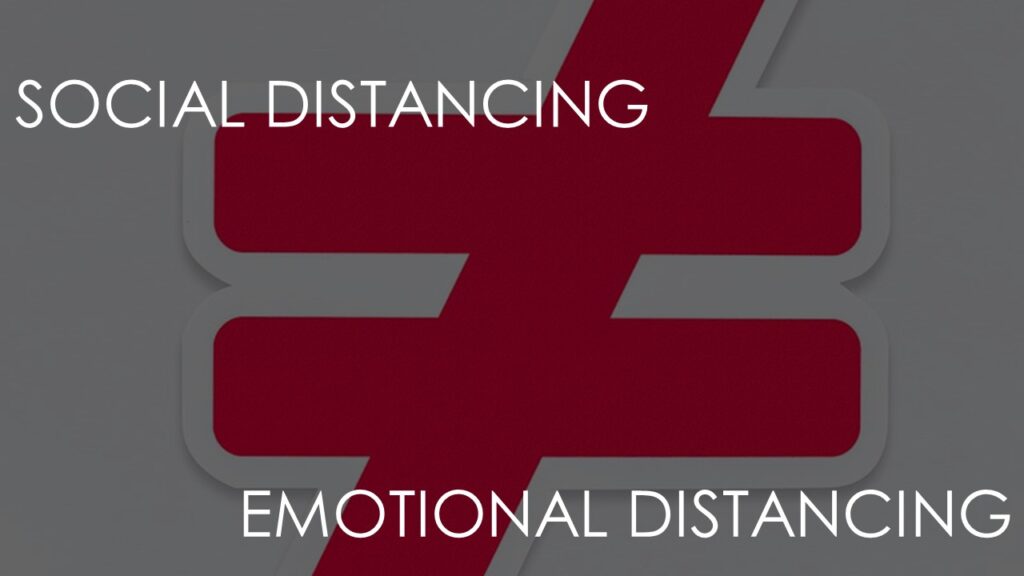
Social Distancing is the norm of the day. Ever since the declaration of COVID 19 as a pandemic, social distancing became a requirement and even a law at certain places. Most of us know that the actual meaning of the so-called social distancing is physical distancing. Physical distancing is a requirement to safeguard ourselves, our loved ones and others from getting infected with this virus on the prowl. During the early stages of the pandemic, the scare was so high that social distancing, many times morphed into social isolation. There are cases of neighbors “spying and reporting” on suspicious visitors to some homes. People in self-quarantine were looked upon with a lot of suspicion and fear. And it became actually a stigma for those who tested positive (and their families).  Pictures of the so called “migrant workers” walking thousands of Kilometers to reach back to their homes became a talking point in global media. Stories of patients being refused treatment in hospitals started flooding the media. Even dead bodies were not given the respect due to them. An unrelated incident in the US triggered strong racial tensions in the United States of America. I am sure I am not alone in having wondered sometimes, “Where is Humanity headed?” But then there were several silver linings among the ominous clouds. Several COVID heroes emerged. Thousands of people and organisations came up to augment the efforts of the government agencies in managing the “migrant worker’s” sufferings. The #BLM movement touched the conscience of Millions. This was a social movement across the globe. These two sides of the coin proved one thing to me. There are some who mistook Social Distancing to be Emotional Distancing, and there are others who took Social Distancing to be a time to actually practice the Servant Leadership behaviour of “Emotional Healing”. I have chosen to write about Emotional Healing, because I believe it is the need of the hour for the world, and business in particular. Emotional Healing is one of the DEEP BHC Behaviours  that mark out a Servant Leader from Traditional Leaders. This is the behaviour that makes Servant Leaders heal themselves and their relationship with others. My earlier blog on Four Habits  dwelt on some attributes that help develop the Emotional Healing Behaviour. True demonstration of Emotional Healing can happen only with a deep understanding of the concept of Grace. Several of us link Grace only with spirituality and faith and divine things. But practicing Grace is essential in today’s world, and it is possible for mere human beings. Only Grace can heal the world of the deep wounds that it is suffering from. So what does Grace mean in our day-to-day lives? Let us begin by looking at Justice. All of us understand Justice well. We build human society on the concept of Justice. Justice, simply put, is “When You Get What You Deserve”. You do something good, you get a proportionate reward, you do something bad, you get a proportionate punishment. All of us crave for justice. All of us raise our voices when injustice is done. This is an easily understood concept. Higher than the concept of Justice is the concept and practice of Mercy. When someone who deserved a punishment is sentenced to get that punishment, all that he/she can do is to plead for Mercy. All judicial systems make allowance for mercy pleas, executive heads can grant that. Mercy, in other words, is “When You are Spared of a Punishment that You Deserve”. So is there something higher than the concept of Mercy? This is where Grace comes in. Grace goes way above and beyond Justice and Mercy. Grace happens when we are not only spared of the punishment that we deserved , but we get a reward that we did not deserve. Grace is “Unmerited Benefit”. Sounds illogical? I agree, Grace is beyond logic. That is why we call it divine. Grace could even be termed as unfair. Yes, at first glance it might appear illogical and unfair. In an emotionally charged world, logic alone is not enough to heal the wounds that are inflicted upon us every day. We need Grace. Justice is required, and is not enough to heal the hurt that is caused due to incidents like George Floyd , or Nirbhaya  or  Pehlu Khan . We need Grace. Only Grace can heal the deep wounds caused by society’s ills. So is there a role for Grace in Business Leadership? Yes, next time when you are tempted to ask, “Does he/she really deserves that”, think about an alternative. Even if that employee does not deserve my time, I will make time for him/her. Even when a team member did not “earn” the right to be developed, I will invest in the development of the team member. Even if the employee has failed in the past, I will give him/her a second chance and entrust a recent project to him/her. Try it out. It will do a world of difference to your organisation’s culture. You may have one question though. Will people not misuse the concept of Grace? The answer is yes, there is a risk that someone might. History shows that every good deed of humanity has been misused by a small percentage of people. The question we need to ask is, should we hold back because a few people might misuse it (the command-and-control leadership), or should we dispense it because several will enjoy it (Servant Leadership)? So don’t let Social Distancing stop you from Emotionally Healing yourselves and your relationship with others, be it at home, in your neighbourhood or at work. Come practice the behaviour of Emotional Healing and join the Servant Leadership Movement. ______________________________________________________________________________________ Dr. Madana Kumar is the Chief Consultant and Servant Leadership Evangelist at Leadyne. You can contact him here.

Social Distancing is NOT Emotional Distancing ; Emotional Healing is the Need of the Day Read More »


Four Reasons Why Servant Leadership is the most suited Leadership Philosophy for the Post-COVID19 New Normal

  We hear about “New Normal” a lot these days. COVID 19 has disrupted our lives and this has spawned a whole new set of studies and theories about what the future could hold for our lives. We cannot escape this even if we want to. As a student of Leadership, my question always is “How does Leadership matter” in this scenario? How does Leadership matter in the New Normal?  John Maxwell gives a crisp but definitive answer to that question. “Everything Rises and Falls on Leadership,” he says, and I agree. So what type of leadership will the New Normal require? I am amazed by the response I get when I ask participants in the workshops to put down the first images that come to their minds when they hear the word Leadership. The responses show an innate deep desire in all human beings to see leadership as something good, leaders as people who do glorious things for their followers. This desire has only got stressed by the COVID19 Pandemic that we are going through. My studies show that there are four specific qualities that people will look for in Leadership in the New Normal. The New Normal will transform the way Leadership uses “Power”: We cannot separate Leadership from Power. It is not, and it never was, the absence of power that distinguished admired leaders from dreaded leaders. It is how the leaders used the powers they had. The old normal of Power Elite, where power was concentrated on a few selected people like Capitalists, or Politicians or Military Leaders will not exist anymore in the New normal. The New Normal will shun the “Power over” syndrome to adapt to the “Power with” syndrome. The new Normal will promote Socialised Power as against Individualized power. Corporate honchos who use power only for profits cannot get many followers in the New Normal. Goodness will prevail over greed. The New Normal will demand excellence in Leadership beyond the achievement of objectives: COVID has made several people realise that there is a higher purpose to life and work. Hence the Old normal of a Leader seen as someone driving the team towards a common aim will not suffice anymore. Followers will start looking for higher purposes in leadership. This will require inculcating several aspects of Spirituality into Leadership. They will demand altruism of leaders. It is not just about what goals we achieved; it is about how much help we provided to the needy, will become a key metric of leadership. Ethics will find its place at the heart of leadership in the New Normal. People will start looking for leaders with top levels of integrity. The New Normal will enforce Values-Based Leadership: COVID has shown us the impact of our actions on others. We have seen several people suffering because of actions (or inactions) by one individual or a group of individuals. Hence people will look for significantly high value-systems in their leaders. It is not enough to be Charismatic or have magnificent vision. What values the leader holds and lives by will become very important. The New Normal will disrupt the chasing of Success and replace it with pursuit of Significance: Successful people were adored and held in high esteem in the old normal. However, the New Normal is revealing the fact that “success” does not always include others. Successful people do not necessarily add value to So the new question that is being asked is not how much value you added to oneself, but how you have used those to add value to others. I have said this before in my earlier blog (Four Personal Habits for laying the foundations of Significant Living in a Post COVID world), Success brings in happiness, which is temporary, which is fleeting. Significance brings in Fulfilment which is lasting, even for a lifetime. So, the world is looking for a new Leadership Paradigm for the New Normal. Is there a Leadership Philosophy that meets all these four criteria? Fortunately for us, the answer is an affirmative “Yes”. Servant Leadership is the answer. Only Servant Leadership can satisfy the innate desire of every human being that Leadership must be for the good of others. Come Embrace this Leadership Philosophy. Come Join the Servant Leadership Movement. _________________________________________________________________________________________ Dr. Madana Kumar, PhD, is the Co-founder and Chief Consultant at Leadyne Organisation Builders. Contact him here.

Four Reasons Why Servant Leadership is the most suited Leadership Philosophy for the Post-COVID19 New Normal Read More »

VALUE: The Five Strong Pillars of Employee Engagement in the Future of Work

I consider the term Human Resources as a misnomer. There!! I have said it and have created angst among many of my esteemed colleagues in the HR fraternity.  Let us face it. What does the term “resource” remind us about? Raw materials used in production? Money used in procuring assets? Machines that convert raw materials into finished product? Do we want to be counted similar to those “resources”? Would you be happy if your organisation treated you as one of the “means” to get the results?  You get the drift. That is probably why many people are switching to the term Human Capital Management. Considering employees as “resources” is not more an option in the future of work. I am not getting pedantic about the terminology. The fact is that the future of work has taught employees to value themselves. The future of work has taught employers to value their employees more. But what does valuing an employee really mean? Let me explain this using VALUE as an acronym. V is for Vision. Employers need to give the employees a string vision , a vision that is not limited by the day-to-day realities of this pandemic stricken world. Servant Leaders create and communicate a strong Vision for the employees. Servant Leaders also persuade followers to buy into the vision and make it their own.  Vision that a Servant Leader creates and communicates is one that I would like to call as Higher Purpose Vision. This gives the employees a greater purpose in life than mere profit. It gives them a cause. This connects them with the organisation in a much stronger way, than when they are a “resource”. A is for Appreciation. Servant Leaders appreciate the value that each team member brings to the table, irrespective of their position or title or level in the organisation. As Ken Blanchard puts it, they “catch people doing the right things”. They recognize and reward people for their achievements. Even when there are failures, they are able to deal with it without devaluing the individual, appreciating their strengths rather than focusing on their limitations. Servant Leaders believe in the saying “It is not what you don’t have that matters most. What you do with what you have that matters most.” L is for love. Don’t beat me up on this. This is not mushy soft stuff. And yes, it is a verb. What has leadership got to do with Love; you ask? “Everything” is the answer of a Servant Leader. Servant Leaders love their people. And in a selfless way. It is not about what they can (or have) done for you, but is about what you can do for them. U is for Uplifting. Servant Leaders truly lift their people up. This is how I define a Servant Leader, “He/she is someone who invests in another person to the extent that the other person becomes better, wiser, richer, healthier, wealthier, more famous that yourselves”. I am reminded of an analogy that a friend of mine narrates to illustrate this. Imagine you have taken your child to a fair/fete. The place is crowded and you are enjoying the sights, there are lights everywhere, there are fireworks going off, people are cheering and smiling. You are enjoying the scene and hope that your child is having a great time. But then you realise that your child is not happy, she is constantly tugging at your hands, your trousers, and trying to get your attention. Finally when you feel pestered enough, you reluctantly lift the child up and put her on your shoulders. Suddenly the child’s face lights up. She starts enjoying the fete/fair as much as you do. Then you realise that when the child was down there, from her point of view,  all that she was able to see was a crowd of feet, dirty shoes, jeans, trousers, skirts, whatever came at her eye level. When you lift her up, you enable her to see the world from your point of view.  Servant Leaders lift other people up so that they can be better. E is for Emotional Connect with people. Servant Leaders connect with people not just at a transactional level. They connect at an emotional level. They are empathetic. They can sense the feelings behind actions and words. They listen to the people for what is being said and what is not being said too. They can heal relationships by forgiving themselves as well as others for mistakes (intentional or otherwise). They have the courage to apologise for wrongs that they have committed. (More on this was discussed in another post of mine accessible here (https://leadyne.com/4-personal-habits-2) So there you have it.  VALUE are the five strong pillars of Employee Engagement in the Future of Work. Several organisations spent enormous efforts to measure and improve Employee Engagement. I offer Servant Leadership as the sure shot solution for this problem. My own research that I did for my Doctoral thesis establishes a very strong and significant positive correlation on the Organisational Commitment of employees when Leaders demonstrate Servant Leadership behaviour. So , do join the Servant Leadership movement and enhance the Employee Engagement in your teams. Join the discussion below.

VALUE: The Five Strong Pillars of Employee Engagement in the Future of Work Read More »

Four Personal Habits for laying the foundations of Significant Living in a Post COVID world

As we prepare to return to the “New Normal” after the COVID 19 pandemic and the associated lockdown side-effects, one question that is being asked by everyone is  “How it is going impact our social life?”. After all, social distancing was the mantra during the COVID lockdown, right? Will the society become more individualistic? Will we be more inclined to “look  after our own safety”? To me, a larger question that we need to address is, what has COVID 19 taught us about the purpose of our lives? Has it helped us to discover our “Why” as Simon Sinek would ask? Has it helped us to realise that there are always choices, lockdown or not? Choices for us to seek Success or to seek Significance? Several experts will agree that pursuit of Success brings Happiness, but pursuit of Significance brings Fulfilment, and it is a no-brainer as to which is better. Happiness is fleeting, it is temporary, it will fade away soon. Fulfilment on the other hand, is lasting (sometime for a life time). One of the lessons I would request all us to consider when we reach the “New Normal” is to ditch the temptation to chase success and to pursue significance. This is an essential trait for Servant Leaders. But pursuing Significance is not easy. It takes effort. It has to be  developed like a Habit, consciously first and then it will come to us in an unconscious manner. That is why we recommend four personal Habits for Servant Leaders. Let us take a look at the four personal Habits, that will help us to lead a Significant Life. These four are by no means exhaustive. To be significant you have to go further than this, but this will lay a great foundation. Habit 1: Take a Pause and Recharge Yourselves. As all of us are aware, our gadgets require recharging very often. However when it comes to ourselves, we ignore that need. Our task oriented life makes us so busy that we keep jumping from one task to another. That  is why we recommend a 15 to 45 minutes of Pause and Recharge time every day for Servant Leaders. Take a break from your tasks and find that 15 to 45 minutes of time to reconnect with yourselves (or a higher power if you are spiritual). It will change the way you see the world, and deal with what the world throws at you. Habit 2: Apologise: Noe of us are perfect and we will mess up things. When we make mistakes (and most of the times it impacts someone else), let us pick up the courage to go and apologise for what we have done. But remember a good apology starts with honesty , and ends with integrity. Because if an apology is not honest or we lack integrity while apologizing, we are likely to make this into a “bad habit”. Habit 3: Forgive: Who among us hasn’t been let down or hurt by someone else? Those who are able to get over it and get going are those who have mastered the power of forgiveness. There are always a thousand reasons for us “not to forgive”. But there is one reason why we should. “Not forgiving someone is like drinking poison yourselves and hoping that the other person will die”. So do it for yourselves, so that you are rid of the bitterness and anger related with the person and/or incident. Habit 4: Self-Healing: Let me repeat again, none of us are perfect and we will mess up. Self-healing is the ability to forgive ourselves and bounce back from our failures. Inability to self-heal will only make us live in guilt for a longer time than required. Let the baggage go, and move on. So those are the four habits that can help us lead Significant Lives. Start practicing them now, so that when we start the “new normal” we are well on our way to becoming Servant Leaders and Significant Leaders. Note that two of the Habits are purely for self, and the other two involve others. That is the beauty of Significance.  Significance in a practical sense is when we add value to ourselves , with the intention of adding value to others. Let us get started. Come Join the Servant Leadership Movement

Four Personal Habits for laying the foundations of Significant Living in a Post COVID world Read More »

Scroll to Top