Leadyne

Articles

Articles

The Myth of a “recalled’ Concept of Triple Bottom Line: It is not Servant Leadership

I have seen many organisations claim that they can be considered as Servant Leadership organisations because they follow the Triple Bottom Line philosophy.  This promoted me to dig a  little deeper into this concept, and what I found amazed me. It was John Elkington who postulated the idea of Triple bottom line in 1994. Soon it became a corporate slogan used by many to present their organisations in better light. They thought that latching onto the Triple bottom line concept will portray their sensitiveness to all the stakeholders, namely Shareholders (Profit), Customers, Employees and partners (People) and Environment (Planet). However, the concept soon became just another corporate jargon.  Elkington himself realised the depths to which the concept deteriorated, and he decided to “recall” the concept. This is probably the first case of a recall of a management concept, though we are used to recall of products and cars and things like that. Elkington did this through an HBR article[1] where he admitted But 25 years later, this radical goal has been largely forgotten, and “triple bottom line” thinking has been reduced to a mere accounting tool, a way of balancing tradeoffs instead of actually doing things differently. Surprisingly, there are several organisations that  still vouch for the Triple Bottom Line concept and proudly project that as their way of balancing results and relationships. Many organisations go to the extent of claiming to be Servant Leadership companies because they follow the Triple Bottom Line concept. This is far from the truth. Of course we are concerned about the shareholders or investors, they bring in the much needed capital to keep the organisation running. Of course we love our customers because they pay us for our products and services. Of course we are concerned about the employees, they do what is required to keep our customers continue to give us business. Of course we take care of the environment out of true concern or out of necessity due to the laws of the land. But that does not make it Servant Leadership. As Jeroen Kraaijenbrink explains in his Forbes Article[2], making grand profit and not doing harm to employees and environment is a basic requirement. The concept of Servant Leadership goes way beyond this narrow understanding of the Triple Bottom Line. I define a Servant Leader as “A Servant Leader is one who invests in the life of another person to the extent that the other person becomes better, bigger, wiser, happier, healthier, wealthier and more famous than the leader himself/ herself” This requires genuine concern and love for people, all people, not just our paying customers or employees. It requires one to have a higher purpose than generating wealth through the organisation. It requires that leaders use their Power to uplift others. It requires that organisations follow a set of values that will make the world a better place. It requires that leaders and organisations need to give up chasing success and pursue Significance. Power, Purpose, Values and Significance are the four tenets that differentiate Servant Leadership from the other good, bad and ugly forms of leadership. I had discussed these in an earlier blog. So if you are still stuck on the Triple Bottom line concept, it is time to give your leadership philosophy a reboot. It is time to consider Servant Leadership. [1] John Elkington:  25 Years Ago I Coined the Phrase “Triple Bottom Line.” Here’s Why It’s Time to Rethink It. Harvard Business Review, June 25, 2018, Web accessed at https://hbr.org/2018/06/25-years-ago-i-coined-the-phrase-triple-bottom-line-heres-why-im-giving-up-on-it on 10th of Nov 2022. [2] Jeroen Kraaijenbrink . What The 3Ps Of The Triple Bottom Line Really Mean. Forbes, Dec 10, 2019. Web accessed at https://www.forbes.com/sites/jeroenkraaijenbrink/2019/12/10/what-the-3ps-of-the-triple-bottom-line-really-mean/?sh=6dc761935143 on 10th Nov 2022. _________________________________________________________ Dr. Madana Kumar, PhD is the Servant Leadership Evangelist at Leadyne. You can connect with him here or contact him here

The Myth of a “recalled’ Concept of Triple Bottom Line: It is not Servant Leadership Read More »

The “People” phenomena of Future of Work

The terms like great resignation, great reset, quite quitting, moonlighting etc., have become part of the HR vocabulary recently. And there are opposing views about all of them. An interesting point of view that I heard is that there is nothing new in these and these have been there in some form or other for a long time now, and we are only giving new names to the old phenomena. I beg to differ. The need to see employees as emotional beings, is becoming more important every passing day. We cannot forget the fact that not too long ago, employees were considered “hired hands”. One of the infamous quotes attributed to Henry Ford goes like this “Why is it every time I ask for a pair of hands, a brain comes attached.“[1] Some other versions put it as “Why is it that I always get a whole person when all I want is a pair of hands?”. Whichever version is true, we get the message. But this situation has changed drastically over the past few decades. Organisations want the brains to come with the hands. The challenge is that even when the organisations accept hands and brains, they would still prefer them to leave their heart or emotions at the door. This is simply impossible. If you need great employees you need to accept them as whole persons, hands, brains, emotions et al. This is the genesis of all the people phenomena that I listed at the beginning. What do organisations see people as? When I used to interview people who wanted to join the HR or L&D functions, I used to ask the question why? And you could easily guess the common answer. “Because I love people”. That got me thinking. Will a CFO hire someone just for their love of money or a CTO hire a person just for their love of technology? A CFO will hire someone who knows how to use money for organisational success. A CTO will hire someone who can use technology for organisational success. By the same yardstick, should a CHRO hire someone who will be able to “use” people for organisational success? The fact is, this is what was happening, and probably is happening even now. When we start seeing people as “resources” problems like great resignation, quite quitting, moonlighting etc. will continue to happen. That is why I used the term “people” phenomena for this. The oxford dictionary defines phenomena as “a fact or situation that is observed to exist or happen, especially one whose cause or explanation is in question.” These phenomena will continue as long as we see people as resources. So what is the solution. In our Servant Leadership initiatives, we use the 3-7-10 framework.  One of the seven DEEP BHC behaviours is Helping others grow and succeed. This behaviour is driven by the attribute of Commitment to the growth of others. We define commitment to the growth of others as People have an intrinsic value beyond their tangible contributions as workers. Committed to a personal, professional, and spiritual growth of each and every individual within the organization. Servant Leaders invest in the holistic development of team members as against the traditional trend of investing only in “monetizable” skills.[2] The concepts of holistic development and value stand out. In an earlier blog I had explained the VALUE framework for employee engagement. Let me present it again with one modification. V: Give them an inspiring Vision A: Appreciate them. “Catch them do the right things (Ken Blanchard)” L: Love: I always get raised eyebrows when I drop the L word. But it is a fact. Bosses love power, leaders love people. Some ways to act out our love in a leadership context is listed in an earlier blog U: Uplift your employees E: Empower them and be available to serve them if they need help. So let us stop debating whether the people phenomena we are seeing as part of future of work are old or new. Let us start looking for ways we can value people beyond their tangible contribution that they bring with their hands and brains. Servant Leadership promotes this mentality naturally. Out of the seven DEEP BHC behaviours, four of them are about relationships. Yes we can achieve a fine balance between results and relationships and Servant Leadership is the answer. [1] https://www.linkedin.com/pulse/bring-your-brain-daren-martin/ [2] Adapted from : Spears, Larry C. Characteristics of Servant Leaders. Chapter 2. Blanchard, Ken; Broadwell, Renee. Ed. Servant Leadership in Action . Berrett-Koehler Publishers. Kindle Edition. 2018 _____________________________________________________________ Dr. Madana Kumar is the Servant Leadership Evangelist at Leadyne. You can connect with him here or contact him here.

The “People” phenomena of Future of Work Read More »

We need an Encounter with Servant Leadership to Change our Character

Character is the building block of individuals and yet, when it comes to choosing people for leadership positions, organisations have given far more importance to skills and abilities than character. This has resulted in some disastrous situations in businesses. Cases of Enron[1] or Satyam Infotech[2] or Peanut Corporation of America[3] or The Volkswagen Diesel gate scandal[4] have been in the headlines at different time of business history. Legislations were passed after the Enron Scandal to prevent such corporate frauds. The Sarbanes Oxley Act[5] was one of them. But have the legislations really succeeded in removing the root cause of the problem? The answer is No. Unless Character becomes a key attribute that one looks for in building leadership pipeline or leadership hiring, such instances will continue to happen and unscrupulous leaders will exploit the loopholes in the system. Leaders and organisations will be able to rationalise their decisions and action, and the stakeholders will continue to suffer. This is why we need a new encounter with a leadership philosophy that places Character as one of the key attributes of Leadership. Fortunately for us, Servant Leadership places enormous importance on Character. The 3-7-10 framework that Leadyne Organisation Builders use for developing Servant Leaders include Character as one of the three leadership imperatives. Servant Leaders place high importance on Behaving Ethically ( one of the measurable behaviours under the DEEP BHC Framework described in an earlier blog). This further builds on having a high level of Awareness and an understanding of Stewardship, an attribute that teaches leaders that they are not owners of anything, but stewards of the resources, talents, organisation and people put under their charge. When Leaders start looking at their positions and possessions through the lens of Stewardship, their mindset will change from one of pride to one of humility. The problem is that many leaders do not realise that they have pride issues. This is where an assessment like Heartstyles assessment[6] comes in really handy. The organisations under the Yum Brand (Pizza Hut, KFC, Taco Bells etc.) have used this tool effectively to bring in transformation in their leadership mindsets.     Another key Character related behaviour that the  DEEP BHC framework promotes is  Emotional Healing, based on a greater understanding of Grace and Forgiveness. This behaviour strengthens the character of a leader to one that works for the good of all stakeholders rather than personal gains for the leader himself/ herself. I had discussed this behaviour in an earlier blog. Let us build leaders with impeccable character. Let us build Servant Leaders!! _________________________________________________________ Dr. Madana Kumar, PhD is the Servant Leadership Evangelist at Leadyne. You can connect with him here or contact him here.   _________________________________________________________ References: [1] https://www.investopedia.com/updates/enron-scandal-summary/ Accessed on 6th September 2022 [2] https://tradebrains.in/satyam-scam/ accessed on 6th Sept 2022 [3] https://www.npr.org/sections/thesalt/2015/09/21/442335132/peanut-exec-gets-28-years-in-prison-for-deadly-salmonella-outbreak accessed on 6th Sept 2022 [4] https://www.bbc.com/news/business-34324772 accessed on 6th Sept 2022 [5] https://www.investopedia.com/terms/s/sarbanesoxleyact.asp accessed on 6th Sept 2022 [6] Heart Styles assessment is the © Copyright of Heart Brands IP PTY Ltd 2008-2018 All Rights Reserved. Leadyne partners with Certified Heartstyles Assessors to help leaders discover themselves.

We need an Encounter with Servant Leadership to Change our Character Read More »

Change your Vision through an Encounter with Servant Leadership

If you follow current discussions on Businesses, you cannot miss the debate over Purpose, People and Profits. Sometimes it is one against the other, other times it is about balancing the three. Traditionally business was about profits, or to use a broader term, wealth creation. This traditional understanding of business is being questioned now. A car requires fuel to take us from point A to point B, but none of us buy a car to just fill in fuel and keep it in the garage. We need to breath to live, but none of us will say that breathing is the very purpose of life. All of us understand that wealth is an integral part of business, but that does not mean that it is the purpose of business. The bottom line is this, businesses need to have a higher purpose. A purpose that is for bettering the conditions of humanity. No one disputes the fact that businesses will and should make money while solving the problems that humanity faces today. Purpose is one of the four tenets that differentiate the good , the bad and the ugly of leadership. I had written about the four tenets in my earlier blog (https://leadyne.com/encounter-the-four-tenets) , the other three being Power, Values and Significance. Purpose is a key part of vision, sometimes purpose is the vision in itself. It answers the question of why are we here? Why does the organisation exist? . Ken Blanchard and his co authors say rightly Leadership is about going somewhere. If you and your people don’t know where you are going, your leadership doesn’t matter.[1] Setting the right vision requires a right leadership philosophy. An encounter with the Servant Leadership paradigm will transform the way you as a leader, and your organisation looks at vision. Servant Leadership is often seen (and dismissed) as an oxymoron. As described in my earlier blog (https://leadyne.com/dcs) this is far from truth and the ability to conceptualise, and dream big of a perfect future is what makes Servant Leadership a reality. This is the first behaviour that we study and measure in our DEEP BHC framework. This behaviour called Demonstrating Conceptual Skills is defined as; Dream Bold and BIG. Participate in, and contribute to, creating a higher order purpose and an unconstrained vision for the organization. Transform a ‘What is’ frame of mind to ‘What if?’ An encounter with the Servant Leadership Paradigm will bring the visioning behaviour as a culture at all levels.   Apart from enabling leaders to set a higher purpose vision for the organisation, a culture of Servant Leadership enables vision setting at all levels in the organisation. There is a myth that the vision can be only at the organisational level. The fact is the contrary. A vision can and must exist at all levels of the organisation. Of course, there is a need for the visions to be aligned. The “Demonstrating Conceptual Skills” behaviour of the DEEP BHC framework (https://leadyne.com/measuring_sl) makes this aspect measurable and hence developable. An encounter with Servant Leadership paradigm will make your vision for yourselves and the organisation an energizing one. When the organisation has a higher purpose than making money, a vision rooted in bringing significance to the world we live in, it will energise people. An example is found at UST (https://ust.com) where the purpose is “Transforming Lives”. Such higher purposes  will help employees rally around the vision. On the contrary, when the organisation has an inward looking vision, the employees are forced to rethink on their association with the organisation. To be the #1…, to be the xxx of choice.. etc are inward looking statements that do not inspire employees working in the organisations. Lastly, an encounter with Servant Leadership paradigm will make sure that the profit motive is achieved automatically. Ken Blanchard says Profit is an applause you get for taking care of your customers and creating a motivating environment for your people.[2] One of the first thing that leaders can do to engage and motivate employees to give them a purpose. A purpose higher than creating wealth or becoming #1 in their business. Yes, you read it right!! Leaders can give a purpose for employees. McKinsey research shows that COVID 19 has prompted several employees to reflect on their life purpose. More importantly, they expect the organisational purpose to help them fulfil their life purpose.[3] Naina Dhingra of McKinsey says, One of the things that we were surprised to find in the research is that about 70 percent of people say they define their purpose through work. And, actually, millennials, even more so, are likely to see their work as their life calling.[4] And the benefit extends to bottom line as well. McKinsey research establishes a positive correlation between purposefulness of employees and their EBITDA.[5] As a leader you have the responsibility of ensuring a higher purpose for your organisation. Have an encounter with Servant Leadership. It will change your vision for good. And for the good of yourselves, your team, your organisation and the world. _______________________________________________________________________________________ Dr. Madana Kumar is the Servant Leadership Evangelist at Leadyne. You can connect with him here, or contact him here.     ________________________________________________________________________________________ [1] Jesse Stoner, Ken Blanchard and Drea Zigami. Leading at a Higher level. Blanchard on Leadership and Creating High Performing Organisations.  Chapter 2. Blanchard International. 2010. Pp17 [2] Don Carew et al. Is your organisation High Performing? Leading at a Higher level. Blanchard on Leadership and Creating High Performing Organisations.  Chapter 1. Blanchard International. 2010. Pp3 [3] Naina Dhingra, Andrew Samo, Bill Schaninger, and Matt Schrimper. Help your employees find purpose—or watch them leave. April 5 2021. McKinsey and Company. Accessed at https://www.mckinsey.com/business-functions/people-and-organizational-performance/our-insights/help-your-employees-find-purpose-or-watch-them-leave on 5 Aug 2022. [4] Naina Dhigra. The Search for Purpose at work Podcast. June 3, 2021. McKinsey and Company.  Accessed at https://www.mckinsey.com/business-functions/people-and-organizational-performance/our-insights/the-search-for-purpose-at-work on 5 Aug 2022. [5] Naina Dhingra, Jonathan Emmett, Andrew Samo, and Bill Schaninger. Aug 18, 2020. Igniting individual purpose in times of crisis. McKinsey and Company. Accessed at https://www.mckinsey.com/business-functions/people-and-organizational-performance/our-insights/igniting-individual-purpose-in-times-of-crisis on

Change your Vision through an Encounter with Servant Leadership Read More »

Servant Leadership : A People’s Movement Impacting the Culture

(Photo by Duncan Shaffer on Unsplash) I am often asked what the biggest hurdle for implementation of Servant Leadership in an organisation is. Of course, we must first get through the first hurdle of leadership-buy-in for the concept itself. This task is made difficult by the amount of myths that exist around the topic. However, once we get through this hurdle, there are still serious mistakes organisations make while driving its implementation. Traditionally L&D or Leadership Development organisations focus on building skills. More mature L&D organisations move up to preparing employees for specific roles. While these two are essential, the problem is when we stop at these. My experience is that if we approach Servant Leadership at a skill level or if we use it only to prepare leaders for their leadership roles, the program is likely to fail and at best will have limited impact. Servant Leadership needs to be addressed at a culture level. This is where the challenge comes in. L&D or Leadership Development organisations think that culture is not within their scope and generally stay away from interventions that build culture. That is why there is a strong case for integrating other Organisational Transformation efforts with the Servant Leadership drive. One of the ways this can be done is to ensure that all other systems and processes like Performance Management, Rewards and Recognition, Feedback mechanism, Goal setting, Learning Policy, Career Frameworks etc. are all aligned to this principle. A more important aspect of this integration is to ensure that the implementation of Servant Leadership is not left to the L&D and/or Leadership development functions within the organisation. It has to be made into a people’s movement. This is best achieved by creating passionate champions within the organisation who will go out of their way, who know the impact of the program, who speak up for the philosophy, who have experienced an impactful change in themselves, and who are more than willing to invest their time in teaching this philosophy to others. Such Champions need encouragement and enablement. This is where a structured Certification process becomes necessary. UST is one such organisation that has embraced this philosophy and is successful in its implementation at a culture level through a network of dedicated Champions from businesses. This group of Champions go through a strenuous but deeply fulfilling Certification process and become Certified Servant Leadership Champions (CSLC). It is through such CSLCs that UST is able to make this a culture, a fact that has been acknowledged by external auditors like  Top Employers Institute (TEI). Leadyne offers this certification to those who are passionate about this topic and would like to know how we can make it all practical.  Leadyne’s Certified Servant Leadership Champions (CSLC) see a sea shift in their own leadership and life philosophy. Many see significant transformations take place in their personal lives. The CSLCs are also well equipped to take the message of Servant Leadership to different organisations, thereby making such organisations be successful in employee centricity and organisational results. Come and consider being certified in this philosophy and become a champion of a cause that will benefit organisations and can create a better world. ____________________________________________________________ Dr. Madana Kumar, PhD is the Servant Leadership Evangelist at Leadyne. You can connect with him here or contact him here.

Servant Leadership : A People’s Movement Impacting the Culture Read More »

Encountering a New Leadership Paradigm: The Four Tenets

An Encounter with the New Leadership Paradigm Part 1: The four tenets of Leadership for the future of work The future of work has been a hot topic of study for the past several years. The question that I would like us to ponder on today is the leadership philosophy that is best suited for the future of work. The future of work requires each one of us to have an encounter with a new leadership paradigm. What is this new leadership paradigm? In this blog we will examine one part of this encounter. Studies reveal that the future of work will be more Hybrid pitting Remote working Vs. Traditional office. The concept of Gig workers or alternate works have been doing the rounds since early this millennium. Employees have a lot of choice in the future of work. Technology plays a a major role in changing the profile of the work, the worker and the workplace of the future. Employees are not happy with organisations that provide a great Employee Experience (EX). They are looking for great life experiences, which often transcend the boundaries of the traditional office. Engaging the employees requires constant innovation. Traditional ways through monetary means alone are not sufficient.  The great resignation proved this point beyond doubt. Employees are looking for a holistic approach from their employers whether it be their well being or upgradation of their skills. The role of leadership in meeting these new challenges cannot be overstated, or over emphasized. My studies reveal that there are four tenets that differentiate the good, the bad and the ugly of leadership of the future of work. Power Purpose Values Significance Power I have discussed this in an earlier blog (https://leadyne.com/power-in-servant-leadership) . The fact is that leadership and power have always been bedfellows and not always the right way. While we acknowledge and accept the fact that there are several leaders who use power appropriately, the list of leaders who misused power is longer in the history of humanity and especially in business history. It is becoming increasingly clear that the employees of the future are not going to respect leaders who use power to further their self-interests. It is not the absence of power that differentiates. It is the conscious choice to use the power “with people” and “for people” as against “over people” that will different the good, the bad and ugly of leadership. Purpose The concept of “Purpose-over-Profit” might have sounded outrageous a couple of decades back. But not any more. Several business leaders are touting purpose as their focus. One of the recent HBR articles on Great Resignation[1] argues that mismatch of personal purpose  with organisational purpose is a major cause of the Great Resignation. In short, while everyone agrees that money is required to keep a business running, making money cannot be the purpose of a business,  just as filling gas in a car is the not the purpose for which we buy a car. Employees of the future are looking for organisations to pursue a higher purpose, a purpose that solves some problems that the current generation is facing or problems that future generations could face. Values Organisational values are an integral part of the culture of the organisation. More precisely how the leaders embody or demonstrate those values, defines the culture of the organisation. Employees f the future will not be satisfied by mere lip service  to values or with just nicely farmed values adorning the wall so the corporate office or the websites. They want to see it in action. They want to see it embedded in the culture of the organisation. Absence of a strong set of organisational values and/or failure of leaders to translate such values in to observable workplace behaviours results in toxic culture. An MIT research into to topic reveals that toxic culture is by far the biggest driver of the Great Resignation[2].  Employees are looking for leaders who espouse a set of values in line with their personal values and moral standards. Significance Corporate culture has eulogized success disproportionately in the past, to the extent of downplaying collaborative work culture. Individual successes have been rewarded bountifully and this resulted in unhealthy competition within organisation itself. Employees of the future are not impressed by individual success of leaders. They are asking the question, what difference did that make to others? What difference did the success of a leader make to me? What difference did it make to the world? What difference will it make to the next generation. This is what I call as the “Life of significance”, that I discussed in my other blogs https://leadyne.com/4-personal-habits-2  and https://leadyne.com/four-reasons-why-servant-leadership-is-the-most-suited-leadership-philosophy-for-the-post-covid19-new-normal These are the four tenets that we need to look at when we encounter the new leadership Paradigm for the future of work. Servant Leadership scores high on all these four tenets and thus becomes a viable alternative for the Future of work. Come and embrace this leadership philosophy. ___________________________________________________________ Dr. Madana Kumar is the Servant Leadership Evangelist and Chief Consultant at Leadyne. You can connect with him here or contact him here [1] The Great Resignation or the Great Rethink?, by Ranjay Gulati, HBR Review March 22, 2022, Web accessed at https://hbr.org/2022/03/the-great-resignation-or-the-great-rethink on 9 June 2022. [2] Donald Sull, Toxic Culture Is Driving the Great Resignation, MIT Sloan Management Review, Jan 11, 2022 . Web accessed at https://sloanreview.mit.edu/article/toxic-culture-is-driving-the-great-resignation/ on 20 Jan 2022

Encountering a New Leadership Paradigm: The Four Tenets Read More »

When Leaders Sit with Clouds

When Leaders Sit with Clouds A few years ago I had the joy of watching the film – What we do on holiday where a couple on the verge of divorce take their three delightful children to the lush English countryside to visit their dying grandfather. The children arrive at their grandfather’s extravagant home which is managed by their rich and rather pompous uncle who begins to introduce the intricate technicalities of the elegant home with an air of arrogance. “This home is very intelligent,” he began to claim. “With a simple clap of your hands the lights switch off…” he displayed quite theatrically. After a couple of cringed filled minutes the youngest of the three children interrupted her uncle’s proud and thunderous moment with a startling question. “How can a house be intelligent?” And her dear uncle’s smile vanished, “well, er…it is..!” His voice is now rising. “Can it do cartwheels?” The 6 year old pushed. “No,” said the uncle with his eyebrows frowning in confusion. The youngling pressed further, “can it draw a peacock?” “No,” came the tired reply. “Then how can it be intelligent?” questioned the perplexed little girl. Her uncle’s face went from red to rage and what happened next was an explosion of sorts which left the children confused as it was obvious that a house cannot be intelligent! There are some fascinating layers and insights hidden in between the interactions of this comic filled scene. Innocent correction has a relentless rawness that can stop the flow of false assumptions adults or leaders tend to make. Correction can create the most awkward and uncomfortable moment for a leader who assumes that everyone agrees with what they are saying or doing at any given time. What helps a leader embrace with ease and effect uncomfortable and awkward conversations at work? Amidst the many attributes needed to usher in such a capacity is the ability to sit still and wait for the awkward moment to fully manifest itself in the atmosphere and settle without the urge to brush it aside quickly. I call it the ability to sit with clouds. We all enjoy the beauty of a blue sky. It’s perfect, untouched and unhindered and yet when I spent several years in India under such a captivating canvas I somewhat lost the value of a fully blown blue sky because it was a daily occurrence (to some degree). When clouds arrived and mingled amidst the vast blueness they created a concoction that gave way to a depth in the blue that made it quite special. It’s very uncomfortable for some leaders to embrace awkward questions at work and for some even mind numbingly embarrassing. Especially if they have been corrected on a matter by a ‘junior’ in public. It reveals 2 blurry blind spots of the Leader. Insecurity & The assumption that everyone accepts everything they say. I say “blurry” because most leaders in this delicate category do not rage like the pompous uncle in the film. They find cunning ways with a camouflaged calm to brush aside the awkward question or correction. In a more dangerous category we find some leaders who have intentionally learned this crafty craft and carved it cunningly into their subconscious. They don’t feel uncomfortable or embarrassed and hence miss the correction completely! An experienced leadership coach has the ability to probe with permission and pass through all the protective layers a leader hides behind (intentionally or unintentionally) in their quest to brush aside embarrassing corrections or any discomforting awkwardness. Insecurity is rooted in fear and that insecurity is a learned tendency however calm it may look on the outside. It takes a courageous leader to allow the leadership coach to probe into sensitive areas where stories of insecurity hide. And the assumption that everyone agrees and understands everything a leader might believe or say is downright ignorance. But ignorance is also learned and needs to be unlearned. Where did you first learn to switch off from the people around you? Does ignoring people make you feel protected? If so, how? When leaders embrace correction or awkward encounters they usher in the idea that there is no ‘junior’ or ‘senior’ and more importantly they carve out a sacred space for safety. It takes a servant hearted leader to allow this life changing legacy to enter the workplace but the process to arrive at that legacy requires rigorous discussions with an experienced Leadership Coach. It can’t be a fully blown blue sky all the time however beautiful that may sound. Clouds are good. They bring perspective to the canvas around us and more importantly they carry rain! And where would we be without rain? Likewise, where would we be without correction? Thomas Edison was corrected 1000 times before he went on to invent the light bulb… So, let there be light! Rahil Patel is a Leadership Coach and leads the practice at Leadyne. You can connect with him here You can contact him here

When Leaders Sit with Clouds Read More »

The Leader and Perfectionist Conundrum – there’s no such thing as tractors!

The Leader and Perfectionist Conundrum – there’s no such thing as tractors!   “How much are you getting done?” Have you ever heard this round-the-clock and overused question? Leaders can persistently ask this peculiar question without thoroughly thinking it through. Like many other phrases and questions, we memorise and monologue throughout our lives without thinking, this one stealthily slips through the net unscrutinised frequently. Contradictorily, for an effective and plentiful outcome in performance the question a leader ought to be asking is, ‘what did you get done?’ And here lies the conundrum. There is a certain segment of leaders who are sequentially blinded by the seduction of a perfectionist’s work who seemingly ploughs through every single task without asking for any help whatsoever. The discreet deception and discoloration veiled by the notion of ‘lots of work being done’ by a perfectionist has a subtle and yet significant impact on the results thereof. When such a blindfolded question is presented to a perfectionist, the outcome will always be deceptively dire. The greater tragedy is that neither will realise that they are unproductive and as a result underperforming. A bit like a farmer pulling his plough painfully by hand in the concealed conviction that tractors don’t exist! Priority over quantity is a constant battle and stressful affair for a perfectionist but it is cunningly camouflaged under continuous hard work. They must attend to everything and everyone. A perfectionist lives under an oppressive illusion that compels them to perform ‘above and beyond’ the required amount all the time! Is it sensible to execute small and insignificant tasks with painstakingly hard work all the time? The reader may know the answer to this but a leader might not…the spell of ‘lots of work’ can comfortably stupefy. Do you know of a perfectionist in your team? Have you ever noticed how distressed they are when they try to meet every demand all on their own? Perfectionists find it difficult to delegate as everything has to be executed in ‘a certain and specific way.’ leading psychologists in the area of perfectionism, Paul Hewitt and Gordon Flett along with the World Health Organisation have even tied mental health issues, anxiety and depression to perfectionism. (An excessively high expectation of one’s self is too much to bear over the long haul). Business leaders and organisations are often unaware of a perfectionist in their workplace, as all they see is a ‘hard working individual’ who says ‘i’ll do it all,’ all of the time… Little do business leaders know that in order to implement everything and that too in a specific manner, perfectionists actually under perform in the marathon of work life. Signing up as a butler to every task they consequently compromise two very key areas. Prioritising Quality execution of important tasks A perfectionist blurs the borders between important and not so important tasks and blinds a leader in the process. The compulsion to ‘do it all’ lends them a scarcity of insight that ‘there are bigger fish to fry.’ Compromising the crucial tasks costs not only them but the leadership above them and the business overall. The first step to unpacking the leadership perfectionist conundrum is awareness. Once the clouds are cleared a comprehensive plan can be charted out for an enhanced performance resulting in effective productivity. A leadership coach carefully carves away at the deception a leader is drawn to when there’s a perfectionist in the room. It’s the clinical role of a coach to highlight all the disguises that can make a leader borderline delusional when there’s ‘lots of work’ happening. And perfectionists can unlearn the habits of “doing it all a certain way and all on my own” through kind but candid questions. “What is the underlying fear of letting some things go? Where did you learn the lie that if everything is not at a certain standard it equates to failure? How and why does the certainty of a certain outcome make you feel in control? What does control look like to you? And so on… Slowly and carefully a Leadership coach can help the Business leader not only peel away at the scales over their own eyes but the perfectionist’s too and performance and productivity begins to take new heights just as the farmer who finally realises that there are tractors after all! Rahil Patel is a Leadership Coach and leads the practice at Leadyne. You can connect with him here You can contact him here

The Leader and Perfectionist Conundrum – there’s no such thing as tractors! Read More »

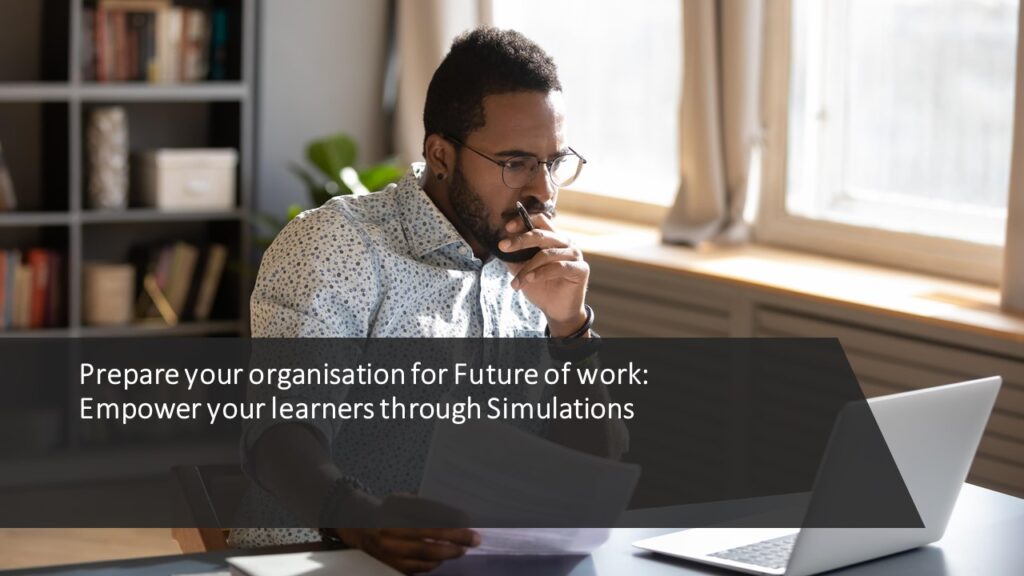
Prepare your organisation for Future of work: Empower your learners through Simulations

The linkage between the future of work and lifelong learning has been emphasized in many studies[i] (ILP and Forbes for example). If lifelong learning is to become a culture in any organisation, there must be voluntary participation from employees. Employers need to invest in creating and sustaining this culture. This does not come easy in traditionally managed organisations. A new paradigm shift is necessary to enable this. In an earlier article, published by CEO Insights India magazine, (also available here) I had written about the need for organisations to democratize learning and empower learners on what to learn.  This is an essential factor for preparing organisations for the future of work. Organisations that have Servant Leadership as an overarching Leadership philosophy stand a much better chance in nurturing this culture. In this blog, let us look at the how part of empowering learners.  How can we effectively empower learners? How can we attract them to the learning opportunities that the organisation is investing in? One of the most effective ways of doing this, is through Simulations for learning. Simulation is not a new subject by any stretch of imagination. The first flight simulator was used for training pilots as early as 1929, almost a century back. Board based simulations were used in corporate trainings often. The advent of eLearning provided a springboard for simulations and rightly so. Simulations became an integral part of blended learning in late nineties or early 2000s. The fact is that they remain an integral part of any learning intervention today and more so in the new normal. The traditional success of simulations revolved around the below aspects (as highlighted in the book Simulations and the Future of Learning by Clark Aldrich , 2004[ii]) Authentic and relevant scenarios. Applied pressure situations that tap users’ emotions and force them to act. A sense of unrestricted options. Re-playability Today we could very well add the availability of simulations over the cloud to this list. But the most critical aspect that makes simulations perhaps the most accepted component of any corporate learning program is the sense of empowerment it gives the learner. The sense of ownership that the learner has when the learner makes a decision, understands the impact of that decision and is given a chance to rectify or learn from that experience is something that no other form of learning can provide. While several organisations do allow mistakes in real job situations and let employees consider mistakes as learning opportunities, simulations provide such a learning at a fraction of the cost of making a mistake in real job situations, especially if the job is mission critical. Airline companies would want to ensure that the pilots use simulations before they let them fly passengers. Nuclear power plants would want to ensure that the safety engineers use simulations to understand the impact of unsafe practices. How about softer aspects like project management or leadership? Our studies reveal that well designed simulations are extremely effective in delivering these types of content as well. Take project management for example. It can be a very dry topic to teach someone in a class room or in a workshop. That is probably why many organisations let employees learn project management on-the-job. What if we could make the theories of project management come alive and provide learners with the delight of making decisions and seeing its impact on the project progress? What if a competitive element could be introduced to create a game like atmosphere? What if this could be done over the cloud with multiple teams competing? This is what UST did in partnership with AXL Learn. This partnership between AXL Learn and UST got them Brandon Hall recognitions in 2016 and 2017. On the leadership front when UST wanted to scale up the Servant Leadership education among its associates and leaders they turned to simulations in partnership with Enparadigm. The results have been amazing for these interventions. Not surprisingly, these initiatives went on to be listed in the Gold level in Brandon Hall awards 2021, in Best of Blended Learning category. Like any other good thing, using Simulations for corporate learning is not without its risks and dangers. At one extreme, it could become laborious and exhausting if the designers incorporate too many possible scenarios in the simulation. On the other extreme, it could become too simple and hence not provide any real learning. The designers must strike a very delicate balance here. The other key aspect that the designers must keep in mind is the quality of content. Great user interface or seamless experience or attractive visuals, are key factors for pure gaming applications. But, when it comes to corporate learning, they are not enough in itself. The content must be cutting edge. That is why the simulation designers must identify and partner with thought leaders on the topic. This is where organisations like Leadyne play a big role. Building a seamless eco system of simulation designers and thought leaders on content is a must for simulations to become the preferred way of learning in the Future of work. Try out the simulation landscape today. There is much on offer and much more to come. [i] https://www.forbes.com/sites/emilyhe/2020/09/22/why-learning-is-the-future-of-work/?sh=20bf820c55ac accessed on 7th October 2021, and Shaping skills and lifelong learning for the future of work International Labour Conference 109th Session, 2021, pp 12 and pp 39-41 [ii] Aldrich, Clark. Simulations and the Future of Learning: An Innovative (and Perhaps Revolutionary) Approach to E-Learning. Germany, Wiley, 2003. Pp 9. ________________________________________________________________________________ Dr. Madana Kumar, PhD is the Servant Leadership Evangelist and Chief Consultant at Leadyne. You can connect with him here or contact him here

Prepare your organisation for Future of work: Empower your learners through Simulations Read More »

Empowerment through Democratization of Learning

In an earlier blog, I wrote about how Servant Leaders empower their employees using the attribute of Empathy. This concept of empowerment is so very essential to creating a learning organisation. Needless to say, learning organisations thrive. So how do we empower our learners and create a culture of continuous learning in the organisation. Let us start with a question. Should organisations focus on the holistic development of employees or invest only on monetizable skills? Thomas Friedman in his book “Thank you for Being Late” emphasizes the fact the Technological advances have overtaken human adaptability. Because of this, employees cannot have the luxury of “taking-time-off-to-learn” but must “learn-all-the-time”. That means they must have access to learn during working hours, during traveling, or doing household chores, etc. In their book “The 100-Year Life–Living and Working in an Age of Longevity” authors Andrew J Scott and Lynda Gratton of the London School of Economics, bring out the fact that today’s employees have multiple choices because of the multi-stage life (as against the three-stage life of earlier times) that today’s generation has access to. This gives an entirely fresh perspective to employee loyalty. Employees who have a choice will require that organisations invest in them as whole persons rather than as “resources” required to meet the organisation goals. One of the major hurdles that come in the way of Holistic development of employees is the concept of Scrap learning. In the early 2000s several people started studying about how much of organisational learning delivered is applied at work. This included illustrious Learning Leaders like General Frank Anderson, and Dr. Robert Brikerhoff. Organisations like KnwoledgeAdvisors who popularized the “Metrics that Matter” concept picked this up, and it is believed that they coined the term Scrap Learning for any learning that was not applied on the job. KnwoledgeAdvisors was later acquired by CEB and then by Gartner. The studies by CEB and Brinkerhoff estimated a whopping 45 to 80% of learning investment as Scrap Learning. This soon became a selling point for Predictive Learning Analytic tools. While the concept of Scrap Learning itself is not wrong, the way it got applied in several organisations became suspect. L&D heads were given yet another metric to prove their existence. The clamor for RoI on every Learning dollar was already high, and the concept of Scrap Learning added to the ammunition of Nay-sayers on Learning Investments. Finance organisations established how many millions they can save if only the L&D function reduced Scrap Learning by as little as 5%. What took a hit was the focus on the Learning culture of the organisations that focused on Scrap Learning maniacally. Such organisations forgot to look at the impact the concept of scrap learning has on employee engagement. Some leaders could not tolerate the fact that employees might spend time (and company’s money) to learn photography or cooking instead of Angular JS. In an actual case that I experienced, that was exactly what happened initially, when we have everyone access to all learning resources from a premier e-learning provider. The leaderboard showed Photography as the most consumed course in the first four weeks. However, my theory was that when you give employees an option to learn, when you democratize what employees learn, they will ultimately learn what is beneficial to the organisation. And accurate enough, the trend changed gradually in the next several weeks and Angular JS became no 1, and photography receded to the 25th position. When organisations insist they invest only in skills that are monetizable or can immediately be translated into business results, the obvious message that the employee gets is this. “You are a resource for us. Hence any investment in you has to have a tangible return”. Contrast this to an organisation that lets employee choose what they need to learn. The message that the employee gets here is “We value you as a person and will invest in your development. You choose what you need for your development”. It is rhetorical to ask which message will give better employee engagement. Isn’t it? Ken Blanchard says “Keep Learning! If you stop, you might as well let them throw the dirt on you because you’re already dead”. I engaged him in a conversation about scrap learning based on this. And I loved his comment. “I don’t know what ‘scrap learning’ is, but I would scrap it”. That sums it up for me. In our Servant Leadership model of DEEP BHC behaviours, H stands for Helping Others Grow and Succeed. This requires commitment to the growth of others described by us as “People have an intrinsic value beyond their tangible contributions as workers. Commit to a personal, professional, and spiritual growth of each and every individual within the organization” It is time to scrap the “Scrap Learning” concept and invest in the holistic development of our employees. Join the Servant Leadership movement and Help Others Grow and Succeed. The returns are prenominal. _______________________________________________________________________________________ Dr. Madana Kumar, PhD is the Servant Leadership Evangelist and Chief Consultant at Leadyne. You can connect with him here or contact him here. An edited version this article also appeared in CEO Insights India website

Empowerment through Democratization of Learning Read More »

Scroll to Top