The servant leadership paradigm | Dr. Madana Kumar | peopleHum

The servant leadership paradigm | Dr. Madana Kumar | www.peopleHum.com Home
The servant leadership paradigm | Dr. Madana Kumar | peopleHum Read More »

Resources
The servant leadership paradigm | Dr. Madana Kumar | www.peopleHum.com Home
The servant leadership paradigm | Dr. Madana Kumar | peopleHum Read More »
The Research that started it all: by Dr. Madana Kumar Download PDF file
Abstract of the Research that started it all – Thesis by Dr. Madana Kumar Read More »
Permit me to ask you to do an exercise. Please do pardon me if you feel uncomfortable doing this exercise. Grab hold of a piece of paper and a pen. I would like you to think for a few moments and write down all the major things you did during this year of the pandemic. All of us had a difficult year and at the same time, the year has opened up opportunities for several of us. We have adapted to several things during the year. Write it down. It might be that your learned a new skill, you published a book, or It might be as simple as baking a cake, it might be buying cloths, it might be decorating the home or whatever. Think and write down please. If you have finished writing it down, go through the list and put a tick mark on the items that were done for others. If you baked the cake for the family, it counts. If you bought cloths for your wife (if she ever allows you to do that; my wife doesn’t trust in my taste, and I admittedly do not have any, in cloths) it doesn’t count (I am kidding, it does). Now, look through the ticked items and identify what you did for your immediate family, immediate relatives, and put another tick mark against the items you did for people outside your family circle. Now sit back and reflect on the items that have the double tick marks. The year is coming to an end with the Christmas being over, Holiday Season coming to an end and a Grand Finale of the New Year celebrations. This is a season of Joy and celebrations, especially as we are bidding goodbye to an arguably most difficult year this generation has faced. All of you know that I evangelize Servant Leadership in corporates, and other Organisations. That is my passion, that is my mission and that is the only legacy that I wish to leave. So, when people ask me to define a Servant Leader, I give them this definition. “A Servant Leader is someone who invests in the life of another person to the extent that the other person becomes better, bigger, wiser, richer, healthier, happier, wealthier, more famous than themselves.” All participants in my workshops are impressed by this definition of Servant Leadership, but soon the “Practical aspects” of this definition starts raising its head. Does it mean that I will need to promote my direct report to be my manager? Does it mean that I give an increment to my team member that his/her salary becomes double that of mine? Practical questions. So, I do have a practical definition, and I do provide a practical definition, so that they don’t get put off by the ideal definition of Servant Leadership that I had articulated above. But in this blog I want to intentionally keep away from the practical definition of Servant Leadership and ask that we embrace the concept of Putting Others First, in all its original intent. May this be our resolution for the new year. Putting Others First. Putting Others First is one of the 7 DEEP BHC behaviours that I had written about in an earlier blog. My research shows that this is one of the lowest scoring behaviours in the 360 degree survey that we run before our SLAM workshops. Let us look at a true story. The story is true, but some of the interpretations are mine in the narration that I have given below. Picture Courtesy: Kevin Carter’s Pulitzer Prize winning photograph of a Sudanese child and a vulture, downloaded from https://en.wikipedia.org/wiki/The_vulture_and_the_little_girl#/media/File:Kevin-Carter-Child-Vulture-Sudan.jpg) Several of you have seen this picture before. This is a picture taken by photographer Kevin Carter in 1993. This is a picture of a famine stricken Sudanese child who was trying to reach the UN feeding center just half a mile away. The child (initially published as a girl, but later believed to be a boy) was exhausted and could not carry on and the vulture was waiting for its feed. Kevin took the picture and it was published in the New York Times. The horror of the famine that was prevalent in Sudan came alive through this picture and this picture alone brought international attention to the situation in Sudan and significantly increased the donations for relief work in Sudan. Kevin Carter went on to receive the Pulitzer prize for this picture. But the story does not end there. Questions were asked about what did Kevin do actually, after clicking the picture. It is reported that he remarked to his wife that he did chase away the vulture. Yes, chase away the vulture but left the child where he was. Kevin did not think it was necessary, or possible for him to help the child reach the feeding center. The situation in Sudan was very volatile and they had limited time (it seems) and their priority was to click photographs. That was the job that Kevin was charted for. So he did his job and certainly was rewarded handsomely for the great job he did. No one really knows for sure whether the boy survived or did really reach the feeding center finally. Kevin certainly did not know. The guilt and the horror of what he saw and what he did not do, weighed heavily on Kevin Carter and he committed suicide four months after receiving the Pulitzer prize. This is a sobering story for us to remember this holiday season. In our hurry to celebrate the season, have we missed someone’s urgent need? In our eagerness to do a great job at what we have been assigned to do, have missed noticing the need of another person? In our eagerness to protest against the restrictions we have had through the year about gathering, partying, worship etc, have we missed actions that could edify (build up) others? When we rejoice in healing that we or a loved
Putting Others First : An Imperative for a Great Post-Pandemic New Year Read More »
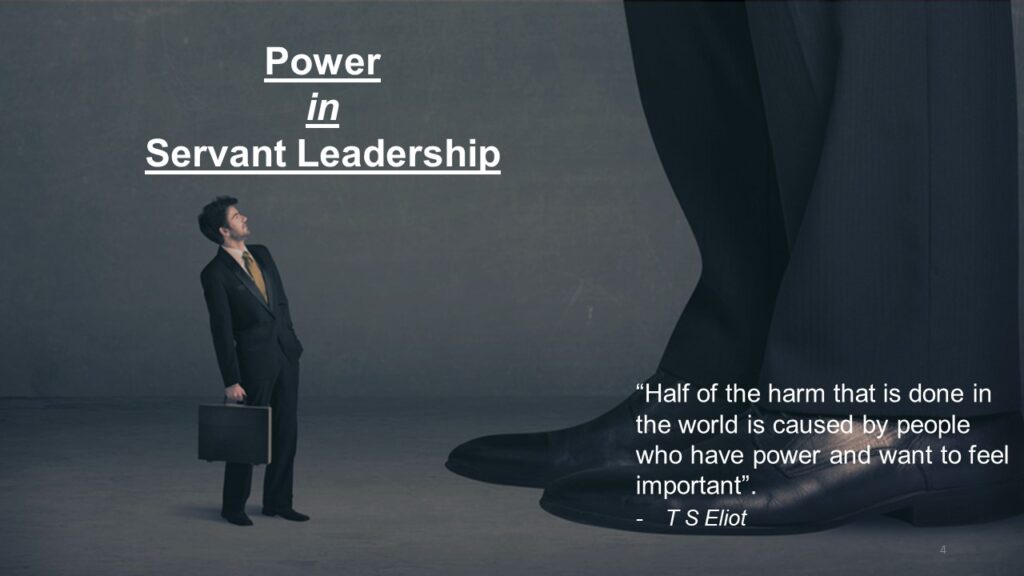
Leadership and Power has always been bed-fellows. We cannot think of one without the other. If we go with the definition that “Leadership is Influence”, then no one is really exempt from being a Leader. Does that mean everyone has some sort of power of otherwise? Researchers agree that we all have power, immaterial of whether hold positions or not. Social Psychologists John R. P . French and Bertram H. Raven conducted a remarkable study about power in 1959 and classified power into 5 separate and different forms. Susan Fowler and Ken Blanchard in their book, Self-Leadership and the One minute Manager speaks about 5 Points of Power that Self-Leaders need to be aware of. As they put it “Not realizing your own power could be your greatest assumed constraint.” In my studies about power, we have seen that each power that we have as an individual or as a leader can be used appropriately or can be misused. History records more of misuses than right uses of power. That is what prompted T S Eliot to say “ Half of the harm that is done in the world is caused by people who have power and want to feel important.” I am sure we nod our heads in agreement at the quote by T S Eliot. We can reel out names of dictators and military generals and politicians who have proven this right, and many continue to prove this saying right even today. Corporates are not devoid of this malady either. It is an accepted norm for “Leaders” to have a bigger office, a reserved parking space, priority seating and servicing at office cafeteria etc. We have come to accept them as part of the office culture and normally do not worry about it. On a lighter note, we might have a laugh if we see an executive rest room in the office premises. Simon Sinek, in his book, Leaders eat last, talks about the former Merrill Lynch CEO Stanley O’Neal. Stan’s story is a true rags to riches story that Ivy League Management Schools drool over. He did make it really big. He made it to the top position at Merrill Lynch in 2002. In his own words “Whatever I have achieved in life has been the result of the unique combination of luck, hard work, and opportunity that can only exist in this country. My grandfather, James O’Neal, was born into slavery in 1861.” In the same year that he took over the CEO position at Merrill Lynch, O’Neal was named the “Most Powerful Black Executive in America” by Fortune magazine. Further instances show that he used that power in a very self-centered manner. He had his own private elevator to go to the 32nd floor and he restricted entry of employees to the floor. He used his power to feel important, and thereby became secluded. This infiltrated into the leadership culture of the organisation. The New Yorker reports that some staffers were referring to the firm’s leaders as “the Taliban” and to O’Neal as “Mullah Omar.” Stan is known to have kept away from the employees and was in touch with only a handful of “faithful” ones. Many analysts believe that this was one of the major reasons for his downfall. He was forced to retire in October 2007, due to the pathetic performance of the company. The legacy that he left was not pleasant. Jim Cramer, the host of “Mad Money,” on CNBC, wrote “This man was Wall Street’s Wicked Witch, a much-feared, totally unrespected hatchet man who appeared to be beloved by his troops but in reality didn’t have a friend in the joint. . . . I swear you could hear the cheering from downtown after he left.” On the other hand, Herb Kelleher, who founded the Southwest Airlines, had a very different idea about Power. He said “Power should be reserved for weightlifting and boats, and leadership really involves responsibility.” And several analysts agree that he was not faking anything. Terry Maxon of Dallas Morning News reports “Whether it’s hugging and kissing co-workers at a meeting or making a 2 a.m. visit to a maintenance hangar, Mr. Kelleher is not happy unless he’s talking with employees.” And what legacy did he leave? Apart from leaving behind the worlds’ most profitable airline company, he also left several thousand employees raving fans of himself. Take a look at what the employees did to thank him. And that legacy did live on in Southwest. Collen Barret , another rags to riches story, and the first woman to have headed a major airline company, took over the President role from Herb. Colleen says “85% of my time is spent on employees and delivering pro-active customer services to employees.” Closer home, Girish Kuber, who wrote the book “The Tatas – How a Family built a Business and a Nation” narrates the story of Jehangir Ratanji Dadabhoy Tata , more popularly known as JRD. One of the first actions that JRD did was to take away the special privileges of officers in Tata Steel Plant at Jamshedpur. This included the special reserved lift for the Managing Director, Special dining areas for officers, and special toilets for officers. If you think this was no big deal, think again. This action was taken in the early 1940’s, when such privileges’ were considered absolutely normal. It was the time of British Raj and sahibs in India. JRD used his powers to make everyone equal, instead of seeking importance for himself or the others in office. It is not the absence of power that differentiates Servant Leaders from Traditional Leaders. It is the conscious choice that they make to use the power that they have for the benefit of the employees. Shakespeare knew it well. He said in his Sonnet No 94 They that have power to hurt and will do none, That do not do the thing they most do show, Who, moving others, are themselves as stone, Unmoved, cold,
Power in Servant Leadership Read More »
The Research that started it all: Servant Leadership in Indian NGOs, A Doctoral Thesis by Dr. Madana Kumar Kindly provide you name and email address to view the following Doctoral Thesis by Dr. Madana Kumar Download PDF file

In my previous blog I discussed the need for Servant Leaders to be able to dream big and keep boundaries while chasing such dreams. At Leadyne, we call it the behaviour of Demonstrating Conceptual Skills. This is the beginning of great organisations. So, what is next? Is setting a higher purpose vision and goals enough by itself? The obvious answer is “No”. Visioning is one of the two key leadership roles. The second one is Implementation. During Implementation of the vision, mission, goals and values, Servant Leaders step aside and invert the pyramid. They create a culture where the employees feel they are fully responsible for the implementation of the vision, mission , values and goals. However the employees also know that the leaders have not gone anywhere. They know they can call upon the leaders as a resource when they need. The employees become responsible and the leaders become responsive to the employees’ needs. They serve the employees in fulfilling the organisation’s vision, mission, values and Goals. This concept is called the “Inverted Pyramid” and is an integral part of Servant Leadership Culture. To make the Inverted Pyramid work, Servant Leaders rely on another of the DEEP BHC behaviours viz; Empowerment. It is a very commonly used word. But let us dig a little deep into it. Is Empowerment something that you “give” to your followers? Have you heard some leaders claim “I have empowered my team fully.” When Empowerment is something that the leader “gives” to their followers, the leader is implying that the power remains with me and I give you the part of that power. This is like claiming that you are most humble person in the whole wide world. Empowerment is not something given, but Empowerment is a climate that is felt by the followers. When they feel that they are Empowered to make decisions, even make mistakes, that is true empowerment. Chris Croft talks about the Freedom Ladder. Servant Leaders need to make conscious efforts to bring their people up the ladder, not by mere words but by appropriate behaviour. Let us take this conversation for example. Quote John: Hi Vinod. I found a problem with the code that we were supposed to release for the client yesterday and I have solved it by making some adjustments. I have released it to the clients and met the timelines committed. Just wanted to let you know and see what you think Vinod: Thanks John. You did well. May I suggest that in future, you pass such things through me before you release it to the clients? Unquote What do you think just happened here? John was at level 4 of the Freedom ladder and wanted to operate from there. Vinod’s reaction was a very clear message that Vinod wants John to be at level 3 of the Freedom ladder. What do you think John will do next time when faced with a situation like this? John is going to suggest and wait for Vinod’s approval before he does anything. In other words, knowingly or unknowingly Vinod has “pushed” John to Level 3 of the Freedom Ladder. This is what happens when the leader is not sensitive to the feelings of the team members while responding, even when the leader considers himself/ herself as am “empowering” leader. Therefore, at Leadyne, we map the behaviour of Empowerment to the attribute of Empathy. Unless as a leader is able to put himself/herself in the shoes of the employee and understand how they feel, empowerment cannot happen. It is important for leaders to understand what the team members think and feel. That is why I said at the beginning that Empowerment is a climate that the team member feels. True empowerment needs that you demonstrate behaviours that will help and encourage your team members to operate from Level 4 or level 5 of the Freedom ladder. Sure, there are risks in doing this. But in the long run, it will become a much stronger team and you as a leader will have a lot of time in your hands for doing higher purpose activities. Come join the Servant Leadership Movement and learn how to make your teams feel empowered. _____________________________________________________________________________________ Dr. Madana Kumar is the Servant Leadership Evangelist and Chief Consultant at Leadyne. You can contact him here. __________________________________________________________________________________ Contact Leadyne if you would like to know the level of Empowerment in your team and wish to improve that.
The Implementation Role of Leadership : Empowerment through Empathy Read More »
Service is Power 1 Feb 2020 In this episode, listeners will discover: The definition of Socialized Power How to practically identify personalized power behavior The 7 Competencies for exhibiting Servant Leadership Show Highlights 0:00 Show Start 4:50 Dr.Kumar Intro 6:25 The difference between Personalized and Social Power 9:48 The dangers of power motivation 13:15 How Servant Leadership overcomes personalized power 17:00… Connect with Madanakumar @ https://leadyne.com/dr_madanakumar Listen in Google Podcast (Click the below button):
Stars of Learning Podcast 2 Oct 2019 Topic: Servant Leadership Journey @ UST Global Dr. Madana Kumar – Servant Leadership Evangelist, a passionate Thought Leader and Strategist on Leadership, and Organisational Learning who speaks at various forums like the NHRD, HR summit, CLO summit, ATD, etc. Currently balancing two roles. one in Corporate as the Vice President and Global Head of L&D at UST Global. Second in Theological Education as Director- Center for Leadership at South Asia Institute of Advanced Christian Studies. He holds a Ph.D. in Business Administration. He has dual Bachelor Degrees, a B.Sc (Physics) and a BE from the Indian Institute of Science. He holds an Advanced Diploma in Business Administration and Certificates on Leadership awarded by the Cornell University, USA. For his Doctoral work, Madana studied the application of Servant Leadership in Indian NGOs. Has won multiple awards nationally and internationally Few questions I ask Dr. Madana Kumar on the relevance of Servant Leadership at larger companies and is it really possible to practice servant leadership and his tips and techniques who is driving this mission & practicing it internally at his company UST Global is as follows: Time Stamps: 5:46 to 37:28 You also call yourself `Servant Leader Evangelist’ what does that mean to you? Why this passion and how did this arise….on `Servant Leadership How did you believe that the Servant Leadership style is appropriate for UST’s digital transformation journey? How did you enable for leaders in UST to embrace it and scale-up, & to stay relevant and be part of this transformation journey? Is there an issue in acceptance of Servant Leadership and how do you engage the direction? How are you making the changes for people to adapt to servant leadership? How did you enable the leadership buy-in to adopt servant leadership? How this is being implemented in UST and how leaders across the system can adopt it in their daily work lives & advantages it can bring to them as a leader? Does Servant Leadership enhance the Employee Engagement in your teams? What is the Commitment from Management to the growth of people in business on Servant Leadership How about `Global Servant Leadership’ in India as well as global at UST? Where do you see this getting applied and breaking the myth and understanding the power of Servant Leadership? How do servant leaders deal with the attention & power of servant leadership? How many leaders will consciously and selflessly let the employees grow more than himself/ herself? Are there any examples of servant leaders in our world and any companies who have adapted Servant Leadership? & where to find more information about Servant Leadership? “Powerful question” to my guest to unveil for my listeners. to engage, enlighten and empower (& that’s the mission of my podcast too) Time stamp at 37:29 to 46:23 According to you, what is the “STAR” moment? What “inspires you” to do everything that you do If you owned the company, what’s one thing you would do differently in learning? What are the three most important things you would like to accomplish right now? What are your strengths? What’s the best book you’ve read this year? or anytime you recommend for my listeners. What are the characteristics of the best boss role models or mentors/coach you ever had? What made that person great? Are there any tools that you use on a daily basis to be a better you? Is there any habit, you are practicing which has made you successful in whatever you do? Your advice for those who want to accelerate their career as a Servant Leader? Authors mentioned in this episode: Robert Greenleaf Ken Blanchard John Maxwell Simon Sinek Resources mentioned in this episode: Servant Leadership in Action by Ken Blanchard A Life of Servant Leadership by Don Frick Companies who follow Servant Leadership Chick-Fil-A South West Airlines Marriott International Wal-Mart Starbucks Connect with Madanakumar @ https://leadyne.com/dr_madanakumar Listen in Google Podcast (Click the below button):
Servant Leadership Journey at a Digital Services Corporate Read More »
