Leadyne

Resources

Resources

Global Servant Leadership

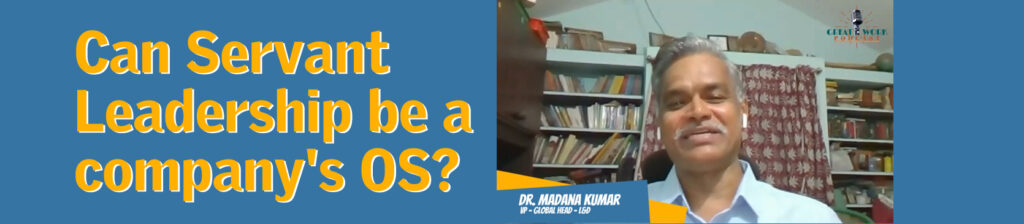
30 Sept 2018 In Episode 10, my mentor in all things Servant Leadership, from Banglore, India Dr. Madana Kumar makes his way on the podcast! Dr. Kumar gives key insight to the core of Servant Leadership, it’s history and some of the numbers and research that proves that Servant Leadership works! Get ready to be convinced that self-serving… The post Episode 10 – Global Leadership w/Dr. Madana Kumar appeared first on Service Is Power. Connect with Madanakumar @ https://leadyne.com/dr_madanakumar Listen in Google Podcast (Click the below button):

Global Servant Leadership Read More »

Servant Leadership : A way of life

7 Oct 2020 Focusing on others, their needs, their views, their successes, doesn’t come naturally to most of us. Especially in a corporate dog-eat-dog world that’s me-centered. But for some, it’s not just a learning philosophy but a way of life. Dr. Madana Kumar has been walking the talk on Servant Leadership as he balances two roles: one as the Vice President and Global Head of Leadership Development at UST Global and, second, as a Servant Leadership Evangelist helping organizations implement and benefit from this new leadership paradigm. With a PhD in Servant Leadership, Dr. Madana leverages his doctoral know-how and close to 4 decades of experience across leading businesses to strategically transform the L&D function, shape the learning strategy of growing organizations, create and nurture a learning culture, and accelerate digital transformation with ‘people-first’ approach at its heart. Connect with Madanakumar @ https://leadyne.com/dr_madanakumar Listen in Google Podcast (Click the below button):

Servant Leadership : A way of life Read More »

Demonstrating Conceptual Skills: Taking Servant Leadership from Oxymoron to Reality

One of the biggest stumbling blocks for acceptance of Servant Leadership in corporate circles is the belief that Servant Leadership is an oxymoron. Critics of Servant Leadership often ask the question “How can one be a servant and a leader at the same time?”. The original definition given by Robert Greenleaf that “A Servant Leader is a servant first…” did not make it any easier for the concept to get acceptance in wider circles. This apparent contradiction in the term is what made Servant Leadership acquire an esoteric nature for quite a long time after it was propounded by Robert Greenleaf in 1970. Several Leadership gurus have tried to break that oxymoron nature of Servant Leadership recently. Notable among them are the works of Ken Blanchard.  Ken dives into the two leadership roles of Vision and Implementation to explain how Servant Leadership fulfills both the roles with a difference. In this blog, let us look at the first leadership role, viz; visioning. In a previous blog I had described the DEEP BHC Behaviours. You will notice that the first behaviour that we have listed there is Demonstrating Conceptual Skills. This is the behaviour that helps a Servant Leader to set a vision for self and the team and/or organisation. This essentially requires two skills viz; Conceptualisation and  Foresight. Conceptualisation is the skill to dream Big Dreams. Servant-leaders seek to nurture their abilities to “dream great dreams.” But what does this actually mean? The ability to look at a problem (or an organization) from a conceptualizing perspective means that one must think beyond day-to-day realities. While we must focus on day to day realities, we should be able to look beyond them and see beyond what is there today. As children we do this intrinsically. As we grow up, we tend to lose this ability to dream big. History shows that  leaders who dreamt big made a difference. Martin Luther King had a dream and that changed the US society. Mahatma Gandhi had a dream that made India achieve independence through non-violence. Nelson Mandela had a dream that changed Africa. Walt Disney had a dream that made Disney Land a preferred place for everyone. Herb Kelleher dreamt of an airline that will give its customers more for less . Let me quote Herb “One of the things that people, I think, didn’t understand is that we started out saying we’re going to give you more for less, not less for less. We’re going to give you new airplanes, not old airplanes. We’re going to give you the best on-time performance. We’re going to give you the people who are most hospitable.”. This was a crazy dream way back in 1971, in one of the most competitive and difficult industries to be in. Chasing dreams at any cost, without boundaries can be dangerous. Servant-leaders must seek a delicate balance between conceptualization and day-to-day focus. That is where the second skill of Foresight comes on. Foresight is the ability to learn from our past experiences, our current realities and the possible consequences of our actions in future. This is what defines the boundaries of what an organisation will do to go after the big dream that they have/had. Several organisations with big dreams flounder and fall through the crack, because they chase their dreams, not paying attention to boundaries. The cases of Enron, or Exxon, or Satyam or Kingfisher Airlines are classic examples of chasing big dreams without foresight. Successful organisations use their foresight to channel the process of chasing the dreams within certain boundaries. Walt Disney did it with their set of values. So did Southwest Airlines. The story of Tata as a group is an interesting study of this aspect too. Let me quote Ratan Tata “Business, as I have seen it, places one great demand on you: it needs you to self-impose a framework of ethics, values, fairness and objectivity on yourself at all times.” Integrity is the top value at Tata Group and that makes them one of the most respected business houses of all times. So this combination of conceptualization and foresight is what results in the behaviour of Servant Leaders Demonstrating Conceptual Skills. This  bursts the oxymoron nature of Servant Leadership. Servant Leaders dream big and have the foresight to avoid the pitfalls of chasing that dream without boundaries. Servant Leaders take on the responsibility of Setting the vision, mission, values and goals for the organisation, and the employees respond to such a vision.   Come Dream Big and join the Servant Leadership Movement. Develop the behaviour of Demonstrating Conceptual Skills We will discuss how Servant Leaders make a difference during the implementation of a vision in the next blog. Watch this space. __________________________________________________________________________________ Dr. Madana Kumar is the Servant Leadership Evangelist and Chief Consultant at Leadyne. You can contact him here. _________________________________________________________________________________ If you would like to know how to develop this behaviour of Demonstrating Conceptual Skills and be a Servant Leader, come and join our SLAM workshops or contact us here.

Demonstrating Conceptual Skills: Taking Servant Leadership from Oxymoron to Reality Read More »

Future of Our Future is Servant Leadership

Stars of Learning Podcast 20 Sept 2019 Dr. Madana Kumar – Servant Leadership Evangelist, a passionate Thought Leader and Strategist on Leadership, and Organisational Learning who speaks at various forums like the NHRD, HR summit, CLO summit, ATD, etc. Currently balancing two roles. one in Corporate as the Vice President and Global Head of L&D at UST Global. Second in Theological Education as Director- Center for Leadership at South Asia Institute of Advanced Christian Studies. He holds a Ph.D. in Business Administration. He has dual Bachelor Degrees, a B.Sc (Physics) and a BE from Indian Institute of Science. He holds an Advanced Diploma in Business Administration and Certificates on Leadership awarded by the Cornell University, USA. For his Doctoral work, Madana studied the application of Servant Leadership in Indian NGOs. Has won multiple awards nationally and internationally Few questions I ask Dr. Madana Kumar on the Legacy of Servant Leadership and how to unlock the potential of being a servant leader is as follows: Time Stamps: 0:01 to 39:30 Why Servant Leadership? What is the concept of Servant Leadership and how it can be practiced To Become a Servant Leader – What are key skills and the responsibility of the servant leadership What are the advantages it can bring to you as a leader? How do we uncap the importance of servant leadership for rising leaders? What are the characteristics of Servant Leader for anyone to resonate…and feel that Wow factor Can you highlight in detail about the acronym VALUE and where Servant Leaders are and need to be different? Is the Servant Leadership Model really relevant to our day to day life? Isn’t it meant for Leaders in the spiritual realm or leaders in the corporate or leaders in NGOs? How about applicability for every individual’s day to day life? How do we convince others about something that we want and look at it as an important element? How would you qualify to be a Servant Leader & how does that one demonstrate? The term Servant Leadership is in itself an Oxymoron. How can Servanthood and Leadership go together? How easy or difficult it is to practice servant leadership? This is not the end! Our conversation continues on the relevance of Servant Leadership and practices at UST Global by Dr. Madana Kumar who is driving this mission internally in Part 2 episode. Authors mentioned in this episode: Robert Greenleaf Ken Blanchard John Kotter Connect with Madanakumar @ https://leadyne.com/dr_madanakumar Listen in Google Podcast (Click the below button):

Future of Our Future is Servant Leadership Read More »

Individual Contributor or Self-Leader? A Servant Leader’s point of view

Servant Leadership for Self Leaders

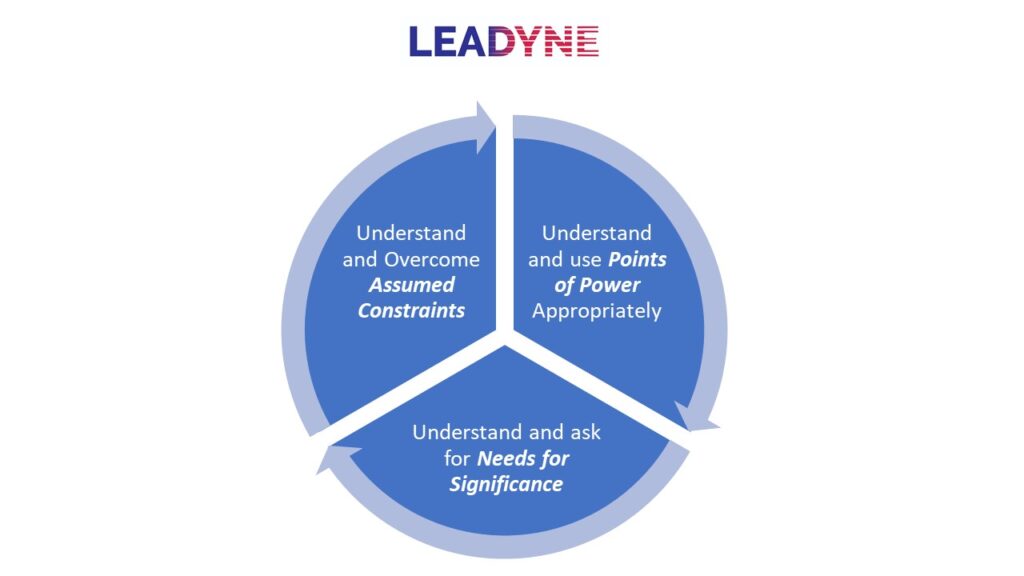
It is quite some time since the term “Individual Contributors” made an entry into the Corporate HR jargon. We assumed that almost everyone starts off as an individual contributor and then grows in the organisation to take up leadership roles and responsibilities. Thus, the term Individual Contributor came mostly to be associated with the bottom of the pyramid in the corporate hierarchy. Then companies started realizing that there might be value in encouraging Individual contributors to stay in that role, especially if they are experts in some field or technology. Companies like IBM even created curated career paths for them, so they don’t have to ever take up managerial positions to grow up the corporate ladder,  but can reach senior positions without taking up management positions at all. Studies reveal that developmental efforts for Individual Contributors is focused more on their technical or task-oriented skills and might be for specific roles. Focused investment in “Leadership Development” of Individual contributors was not a focus. Jack Zenger in his article in the Forbes Magazine (way back in Feb 2014) claimed that Individual contributors are “Forgotten Leaders” in investment from organisations on Leadership development activities. Several Organisations ask, “What has leadership development got to do with Individual contributors?” That led me to the question. How about Servant Leadership? Can an organisation really develop a Servant Leadership Culture by focusing only on who we traditionally call leaders? And the answer is “no”. A Servant Leadership culture requires that we focus on this group of “forgotten leaders” as much as we focus on traditional leaders. All individual contributors are “leaders” if we go by the definition “Leadership is Influence”. That is why I refer to Individual Contributors as Self-Leaders. What do these Self-Leaders need to do so they can take the best advantage of a Servant Leadership culture in the organisation? What attributes or mindset changes or behavioural changes do they need to embrace so they thrive in a Servant Leadership Culture and make the organisation successful? My studies show that there are three areas where they need to develop. (Ken Blanchard and Susan Fowler articulate this better in their book “Self-Leadership and the One Minute Manager”) Understand and overcome one’s Assumed Constraints: Susan Fowler speaks about the Elephant syndrome in several of her writings to explain Assumed constraints. The fact is that several of us end up assuming that there are several constraints that prevent us from becoming the best we can be. A significant Self-leader will strive to understand ones assumed constraints and look for ways of overcoming those. They will break the “permission paradox”  (a felt need to have explicit approval of someone before taking any action) and climb up the Freedom Ladder/ Autonomy ladder to become empowered employees and team members. Understand and use “Points of Power” the right way: Everyone, immaterial of any position or seniority, has some powers. As history proves repeatedly, it is not the absence of power that differentiates infamous leaders from the excellent ones. It is how they (choose to) use their powers. A Self-leader will understand his/her own points of power and the points of power of their team members. Once they have this understanding, they will then use this knowledge to bring fulfilment to self and success to the team. Self-leaders aware of their points of power will use such knowledge to collaborate rather than for conflict. Understand what you “need” to be significant: Self-leaders need to understand that chasing success is not the right thing to do. Individual success might bring in some temporary happiness, but it is in adding value to others that we find fulfilment. This is what we call significance. Self-Leaders will know what they need to be significant and they will know the right way to ask for the same. This awareness of your own “significance needs” will help you understand the current development stage that one is in. This will help in prioritising your goals so you can focus on the most significant ones. These are the building blocks for Self-Leadership. So let us not forget the “Individual Contributors”. Let us invest in them and make them significant Self-leaders. This will speed up the spread of Servant Leadership culture within the organisation. _______________________________________________________________________________________ Dr. Madana Kumar is the Servant Leadership Evangelist and Chief Consultant at Leadyne. You can contact him here _____________________________________________________________________________________ If you would like to know more about how Servant Leadership can be made practical for Individual Contributors, do get in touch with us .

Individual Contributor or Self-Leader? A Servant Leader’s point of view Read More »

Nebulous to Specific: Measuring Servant Leadership Behaviors

  All of us have heard the cliché “ What can be measured can be improved”. One of the several myths associated with Servant Leadership was that it is a nebulous concept which cannot be quantified and/ or measured. This myth was strengthened by the views of the early proponents of Servant Leadership who were not in favour of “measuring” Servant leadership attributes. The focus was on experiential understanding of the concept. Don Frick, who wrote about Robert Greenleaf, was probably referring to the father of the term himself when he said that it was believed that if servant leadership was reduced to a collection of admirable qualities and learned skills that were displayed in organisational settings, it was all too easy to forget that servant leadership was, first about deep identity.  Another apprehension was that we may feel guilty and frustrated for not measuring up to this set of leadership ideals and that we may even project these ideals onto others; expecting them to do what we could not attain ourselves. Due to this, most of the early writings on Servant leadership have been based on anecdotal observations, personal testimonies and reflections. However, a body of researchers argued against this view and attempted measuring Servant leadership attributes. In the early 2000’s many researchers came up with scales that measure Servant Leadership behaviours. Picking up on this research, and banking on a scale that was developed and validated by Dr. Robert C Liden, I developed a scale called the Menorah Servant Leadership Assessment (MSLA) , as part of my doctoral studies. Making it part of the doctoral studies ensured that the scale went through rigorous validations tests and can relied upon. So, the good news is that Servant Leadership behaviour can be measured. The MSLA measures Servant Leadership against seven distinct behaviours we call as the DEEP BHC behaviours. Let us look at them briefly MSLA measures these seven behaviours as a 360 degree assessment. It gives an opportunity for the leader to compare own perception with what others actually see. It also gives an idea of how the  leader stands with respect to a global population and/or his/her organisation. MSLA is a great tool for self-awareness for all leaders. You can get more details about the MSLA here. So, Now that you know that Servant Leadership is  measurable, it is no more considered a nebulous concept. Come, take the MSLA assessment and be a great Servant Leader. Your Servant Leadership journey starts with a 360 degree assessment. _______________________________________________________________________________ Dr. Madana Kumar, PhD is the Servant Leadership Evangelist and Chief Consultant at Leadyne. You can contact him here.

Nebulous to Specific: Measuring Servant Leadership Behaviors Read More »

Victim, Villain, Hero or a Fourth Alternative?

By now, you must have heard it a thousand times. We are living in unprecedented times. We are going through trials. We are preparing for the Future Shock or a new normal. The world is not going to be the same again etc etc. We cannot escape the reality of the pandemic that is still raging out there. But we are also encouraged by the fact that life is slowly limping back to normal. Most of us are learning to “live with” the pandemic. In this blog,  I will ask us to turn the attention on us, on our responses, on how we respond to such trying times. And what can we do as leaders, to be a lot more effective in such situations. Recently I had the privilege of listening to the author Don Phin, and then read his book, the 40-40 Solution. Don Phin talks about three roles generally all of us audition for viz;, Victim, Villain or Hero.  The book inspired me to think about these three categories in a different context.  My studies show that these three are the standard responses of people to troubles. Come to think of it, you will see these three roles in any Hollywood or Bollywood movie that you catch on Netflix or Amazon prime or Hot-star or wherever you see movies during the pandemic. Let us look at each one of these three and see which one fits us more. The Victim response is probably the most familiar one to all of us. When faced with troubles the Victim will feel that it is unfair. The victim will feel singled out. The victim will think the entire world is conspiring against him/her. Their conversation with friends will be about how hard life is. They will strongly feel that others are more blessed than themselves. They truly believe that others do not know how difficult his/her situation really is. They will blame others and/or situations for their suffering and troubles. They think no matter how hard they try, their situation will not change. They find it difficult to get over the past mistakes and failures, and they perpetually live in guilt. You can add on to this list, but I am sure all of us have felt some of the above sometime or the other. Victims are people who feel some of these often. Psychologists opine that Victims, as and when they can get out of the victim state, end up becoming either a Villain or a Hero.  The Victim to Villain transition is very natural..  When one gets fed up with staying in the victim stage, a victim will start planning actions that can hurt others. That is when the Villain is born. A Villain will take revenge. A villain will become aggressive, violent, and will hit back at others with whatever he/she can. A villain will not worry about public opinion. A villain will soon start enjoying the role so much that he/she will fall in love with themselves in that role to the detriment of others.  Many of us might not be explicitly getting into a villain role, but think again. We are taking the villain role, when we scream at someone, we are taking the villain role when anger gets the better of us, whether it is at home or outside. Sometimes we get into a villain role without even realizing it. A more positive transition is the one from Victim to Hero. A Hero does not have to come out of a victim. Heroes emerge otherwise, too. A Hero wants to save. This is what psychologists call the Savior’s Complex.  Someone with a Hero Mentality will swoop down on a suffering victim and do all that is necessary to save him/her. At the outset, you may think there is nothing wrong with being a Hero. But think again. All that the Hero might care about is saving the Victim. A Hero might not seek the Victim’s permission or acceptance before getting into the saving act. He/ she might not enable the victim to get over the situation. The Hero might not bother about making the victim self-sufficient. The Hero might not bother about their own safety and/or well-being while doing the saviors act. The Hero will sometimes even endanger himself or herself and many around them, including their own families to perform the rescue act. Let us pause for a moment and ask ourselves this question in the middle of the pandemic we are in. What role are  we auditioning for? Do we feel like a victim of the situation around us? Are we tempted to take on the Villain role, so we can take revenge or we can “pay back” for the sufferings we have gone through? Or are we donning the cape and taking the role of a superhero, trying to save everyone who is suffering, not bothered about our own safety and the well-being of the ones who love us? There is a fourth option, an option of being a Leader. We don’t have to be stuck inside the Victim-Villain-Hero Triangle. So what does the fourth option entail?  What does “Being a Leader” mean in this context? Being a leader as the fourth option here means we demonstrate the behaviour of Emotional Healing that I wrote about in a previous blog. It means Leaders who practice  the four habits that I wrote about in another  blog. It means we seek to add value to ourselves with the explicit purpose of adding value to others, as described in yet another blog on significance. It means being a Servant Leader. ______________________________________________________________________________________ Dr. Madana Kumar is the Chief Consultant and Servant Leadership Evangelist at Leadyne. You can contact him here.

Victim, Villain, Hero or a Fourth Alternative? Read More »

Scroll to Top